Sharjah Takes Off with Air Taxi Study
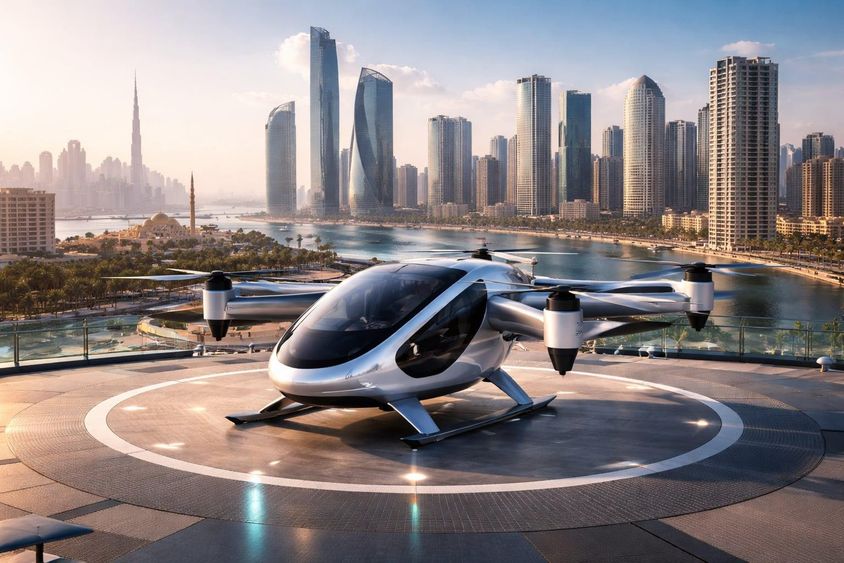
Sharjah Approves Study on Air Taxi Fares for New Transportation Project
Sharjah has taken another decisive step towards the future of transportation. The emirate's executive council has approved the launch of a comprehensive study examining the details of a modern air transport project, which includes the exploration of air taxi service fares and freight transport possibilities. This decision is not just a prelude to a technological innovation but a strategic message: Sharjah aims to solidify its position as a pivotal hub of inter-city air connectivity in the region.
The project is currently in its feasibility phase, but the approval itself already signals that the emirate is thinking long-term. Sustainability, future technologies, and international cooperation form the triad that defines the direction. The goal is to create an ecosystem that not only offers a faster but also a cleaner and smarter transportation alternative compared to traditional road solutions.
Air taxis as an urban revolution
The concept of the air taxi is based on electric vehicles capable of vertical takeoffs and landings, known as eVTOL systems. These vehicles can ascend like a helicopter but travel more efficiently and quietly like an aircraft. They represent a new dimension of urban mobility, linking key points in minutes over pre-determined air corridors, flying above traffic jams.
For Sharjah, examining fares is a key issue. An innovative service can only be successful if it is economically viable and not accessible only to a narrow elite. The study's purpose is to develop a fare structure that balances the costs of technological investment with market realities.
The project extends beyond passenger transport. The integration of freight transport opens up new possibilities for fast logistics solutions, particularly offering a significant competitive advantage for high-value or time-sensitive shipments with direct, congestion-free air delivery.
The UAE at the forefront
In recent years, the UAE has consciously positioned itself at the global forefront of advanced air mobility. Abu Dhabi, Dubai, and Ras Al Khaimah have already introduced their plans and partnerships for launching commercial air taxi services. Sharjah now joins as the fourth emirate, indicating that domestic competition and cooperation are simultaneously driving innovation forward.
Plans are in place for the necessary certifications to be issued this year, allowing commercial flights to commence by 2026. If realized, the UAE could become one of the first countries where the air taxi is not an experimental project but an everyday mode of transportation.
In Abu Dhabi, successful test flights have already been conducted, and more than ten vertiports—dedicated takeoff and landing sites—are planned. These will be built at strategic points near airports, business districts, and urban hubs, forming an integrated network.
Dubai has also made spectacular progress. After the first successful flying taxi tests, infrastructure development commenced, including a vertiport connected to Dubai International Airport and additional sites in areas like Palm Jumeirah and Dubai Marina. The goal is clear: drastically reduce travel time within the city and, in the long run, redefine inter-emirate connectivity.
In Ras Al Khaimah, plans suggest that air taxis will connect Dubai with Al Marjan Island and the Jebel Jais area. What takes over an hour by car could be reduced to just fifteen minutes. This is not just a matter of convenience; it is also an economic and touristic development of significance.
Sustainability and urban strategy
Sharjah's decision closely aligns with sustainability goals. The electric-powered eVTOL vehicles operate with significantly lower noise levels and emissions than traditional aircraft. The future of urban transport is increasingly moving towards electric and autonomous systems, and Sharjah intends to embrace this direction.
Air taxis are not only transportation tools but also city development tools. New business districts, logistics centers, and residential areas could join the circulation if distance and travel time are drastically reduced. This could influence the real estate market, investment decisions, and tourism in the long run.
The approval of the study is not an isolated step but part of a comprehensive vision. Reviewing the progress of governmental work and reaffirming public policy directions show that the emirate approaches development in a complex manner: technological innovation, social well-being, and economic diversification are among the goals.
Social dimensions and vision for the future
In addition to the transportation project, policymakers also made decisions about the allocation of residential and investment lots to over a thousand beneficiaries. This parallel development direction—modern infrastructure and housing support—suggests that Sharjah aims to achieve not only a technological leap but also strengthen social stability.
If the air taxi service is launched in 2026, the UAE could become a global reference point in advanced air mobility. The question is no longer whether this future will materialize, but how quickly it will become everyday reality. Sharjah has now taken the first official step: by examining fares, business models, and the foundations of infrastructure, it is laying the groundwork for an era where inter-city travel takes on a new meaning.
The coming years will be critically important. If technological, regulatory, and economic conditions converge, the air taxi will not just remain a futuristic sight but could become one of the region's most defining transport innovations. With this step, Sharjah has clearly indicated that it does not wish to fall behind but wants to be an active shaper of the future of mobility.
If you find any errors on this page, please let us know via email.


