Abu Dhabi's Road Safety Revolution
Abu Dhabi's New Speed Limits: Key Changes for Safer Roads
The transport system in the United Arab Emirates is continuously evolving, and a prime example of this is Abu Dhabi's new speed limit measure, which will take effect on February 9, 2026, on three major road sections. The updated regulations aim to reduce the number of accidents, improve road safety culture, and minimize personal and property damage. While a single speed limit adjustment might seem insignificant at first, it can actually have a significant impact on the dynamics of daily traffic.
Which roads are affected by the modification?
The new regulations affect three major sections:
Abu Dhabi–Al Ain Road (E22): From Al Nahda interchange to Bani Yas interchange, the maximum permitted speed in both directions will be reduced from 160 km/h to 140 km/h. This section is particularly busy as it connects several residential areas and industrial zones, so slowing down will increase reaction times and stopping distances, thereby improving safety.
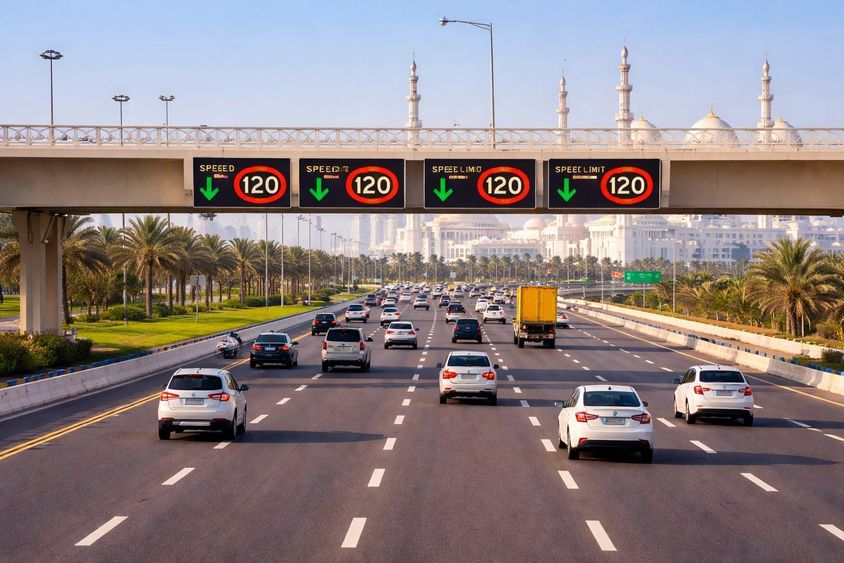
The section between Bani Yas interchange and the Bridge Complex: Here, the limit will be reduced from 140 km/h to 120 km/h. This measure is also intended to make traffic smoother, especially during peak periods.
Al Rawdah Road (E30): The speed limit will be modified from 120 km/h to 100 km/h. This section is particularly sensitive due to urban connections, so the restriction aims to reduce the risk of sudden braking and lane changes.
This is not the first step: previous changes on major roads
The new announcement is not an isolated decision but part of a longer process. Significant modifications already took place in April 2025:
Sheikh Khalifa bin Zayed International Road (E11): The 160 km/h limit was reduced to 140 km/h. This highway is of critical importance between Abu Dhabi and Dubai, so the change affected not only Abu Dhabi residents but also the mobility of the entire region.
Abu Dhabi–Sweihan Road (E20): Here, the 120 km/h limit was revised to 100 km/h, also in the interest of enhancing safety.
Abolishing the minimum speed rule and its impact
Many were unaware that previous regulations included a minimum speed requirement: for example, on the Sheikh Mohammed Bin Rashid Road (E311), a minimum speed of 120 km/h was mandatory. This minimum has now been abolished, which is beneficial for several reasons. First, it becomes easier for heavier vehicles such as trucks or vans carrying cargo to move, and second, the 400 dirham fine for violating the minimum speed rule has been eliminated. This is particularly advantageous for those who prefer to drive at a safer pace consistent with their vehicle's technical features.
Dynamic speed limits: future technology arrives in Abu Dhabi
Another major innovation was realized starting in October 2025: the introduction of the variable speed limit (VSL) system on Sheikh Zayed bin Sultan Street. This system regulates speed limits based on real-time information, considering current traffic, accidents, construction, or weather conditions. The system operates on a central control system that processes data from sensors and cameras, then displays the valid speed on digital boards. This allows traffic to truly adapt to the current situation, not just a static rule, thereby making road travel not only safer but also smoother.
Why are such steps necessary?
The reduction of speed limits and technological innovations are not without purpose. According to Abu Dhabi's transport committee, the primary goal of such measures is to prevent fatal and serious accidents. Speeding is still one of the most common causes of accidents in the UAE, especially on long, straight, and high-quality road sections where drivers often exceed safe speeds.
These changes are part of a comprehensive road safety strategy that includes the use of speed cameras, the development of traffic lights, increasing public awareness, and the gradual introduction of new VSL systems.
Summary
Abu Dhabi is transforming its transportation system step by step, based on conscious planning. The reduction of speed limits, the abolition of the minimum speed rule, and the adoption of variable speed limit systems all indicate that the emirate is thinking long-term about road safety. The new measures may not only reduce the number of accidents but also contribute to more sustainable and smarter urban mobility. For drivers, this means attention should be paid to displays, adaptation to the new rules, and prioritization of safety—for their own protection and that of others.
If you find any errors on this page, please let us know via email.