UAE and EU: A New Trade Horizon
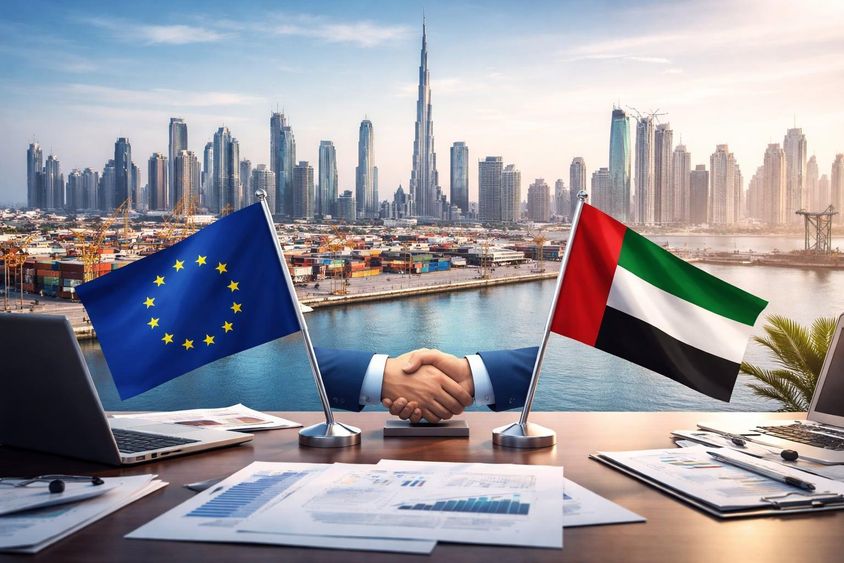
UAE and EU: On the Verge of a New Free Trade Era
2026 could be a new milestone in the economic relationship between the United Arab Emirates and the European Union. Initiating negotiations for a bilateral free trade agreement between the two parties not only opens a new chapter but could fundamentally reshape the relationship between the EU and the entire Gulf region. Instead of the decades-long stagnant GCC-EU agreement, the dynamics could finally bring results in the region's economic integration starting with the Emirates.
The Role of the Emirates as the Economic Hub of the Region
The United Arab Emirates has already been a key player in the region: with its logistical capacities, world-class ports, advanced financial infrastructure, and investor-friendly regulations, it has become a true regional center. With this move, the EU not only acknowledges the economic significance of the Emirates but also secures a strategic position, making it easier to access GCC markets.
The planned focus of the new agreement targets areas that are crucial for both parties: artificial intelligence, renewable energy, digital technologies, sustainable logistics. These are sectors that form the foundation of the EU's future growth strategies and in which the UAE is already executing cutting-edge developments.
Why is This Happening Now?
The answer partly lies in the international context. The European Union has sealed trade agreements in quick succession with India, Indonesia, and Latin America in the past year. This dynamic is a response to geopolitical shifts: Europe is seeking new trade routes and building on partners that are stable, open, and strategically significant. In this context, the Middle East, more specifically the Emirates, plays a prominent role.
Simultaneously, the institutional framework established over recent years is finally bearing fruit. Annual foreign ministerial meetings between the EU and GCC countries, the Structured Security Dialogue, and the establishment of the EU trade chambers in the region are tools that ensure stable, ongoing dialogue and progress.
A Two-Level Strategy: Political and Economic Layer
The bilateral agreement being initiated is only the first step towards a more complex cooperation consisting of two layers. On one hand, a free trade agreement will be formed between the UAE and the EU, while parallel negotiations are ongoing with each GCC member state to establish strategic partnership agreements. This combined model ensures that the economic integration does not become merely a trade-focused connection but is supported by political collaborations as well.
Thus, the EU not only gains one country, but opens the door to an entire region — advancing step by step. In this system, the Emirates can serve as not just an "entry point" but also a model for other GCC member countries.
Long Preparation Finally Bearing Results
Formal relations between the GCC and the EU have existed since 1988, yet it is the past three years that have seen real progress. The long-protracted period, often filled only with symbolic gestures, is now replaced by intensive negotiations and concrete results.
The new contract between the Emirates and the EU should not only be viewed as a bilateral agreement but also with regional implications. If negotiations are concluded by 2026, it could impart new momentum to the long-held GCC-EU free trade agreement.
Outlook: A Shared Future for India, Europe, and the Middle East
The agreement between the Emirates and the EU also fits into a larger geopolitical vision that envisages the Middle East as a bridge role between Europe and South Asia. The recently sealed EU-India agreement and regional infrastructure plans — such as the development of rail and sea connections along the India–Middle East–Europe economic corridor — indicate that the future economic axis is shifting in this direction.
In this system, the UAE — and particularly Dubai — could serve not only as a transshipment or logistics center but also as a hub for digital innovation and green technological developments.
Summary
The year 2026 could be the year of breakthrough in the relationship between the EU and the Gulf region. The Emirates play a central role in this new phase — not only through its own development but also as a model for the whole region. This way, the EU gains a strategic partner that is reliable, dynamic, and future-oriented.
The launched bilateral negotiations thus represent much more than just another trade agreement: they could lay the foundations of a new economic era where the EU, the Middle East, and South Asia shape the future of the global economy together.
If you find any errors on this page, please let us know via email.


