Oil Prices Surge, Gold Holds Steady
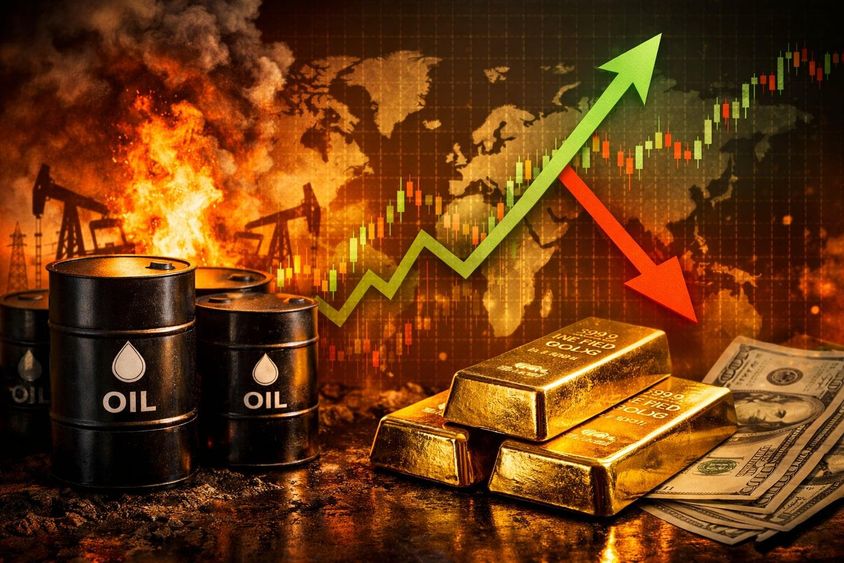
Oil Price Explosion and a Resilient Gold Market – Why Do the Two Classic Safe Havens React Differently?
In recent times, global financial markets have exhibited a phenomenon that is interesting but difficult for many to understand at first glance. While the escalating tensions in the Middle East are causing oil prices to soar, gold – traditionally considered one of the world's most important safe-haven assets – does not show a similar surge. The price of oil has surpassed $100 per barrel, while the price of gold has stabilized around $5,000 per ounce, without embarking on a spectacular rally.
This difference illustrates well that modern financial markets react to geopolitical events in a much more complex manner than in previous decades. Behind the price movements of these two commodities are completely different economic mechanisms that collectively shape investor decisions.
The Direct Cause of Rising Oil Prices
The rapid rise in oil prices is primarily linked to very specific physical risks. The conflict in the Middle East can impact one of the world's most important energy trade routes, the Strait of Hormuz. This sea passage is crucial as nearly one-fifth of global oil supplies pass through it.
Any disruptions, even temporary ones, at this strategic point can immediately tighten global supply. Traders quickly price in potential supply issues, leading to sudden price increases. Mere uncertainty is enough for market participants to pay higher prices for future deliveries.
In the current situation, investors fear that the conflict could affect several million barrels of daily oil supply. Such a risk could represent one of the most significant disruptions in the history of the energy market, hence oil prices are particularly sensitive to any new developments.
Why Doesn't Gold Surge Accordingly?
Gold is traditionally regarded as a safe-haven asset. When uncertainty grows in the world, many investors automatically turn to the precious metal. However, in the current market environment, several macroeconomic factors are acting to temper this classic reaction.
One of the most important factors is the strength of the dollar. In times of crisis, investors often seek both liquidity and safety. The dollar in this situation is a particularly attractive asset, as it is one of the most important reserve currencies in the global financial system.
When the dollar strengthens, the price of gold becomes more expensive when calculated in other currencies. This reduces international demand, as buying the precious metal becomes more costly for many investors. Thus, the strengthening of the dollar often offsets the demand arising from gold's role as a safe haven.
The Impact of the Interest Rate Environment
Another key factor influencing the price of gold is interest rate developments. In the current situation, higher oil prices raise fears of inflation. If rising energy costs cause persistent inflation, central banks may be forced to keep interest rates high for longer.
However, a high-interest-rate environment is unfavorable for gold. The precious metal does not yield interest or returns. When bonds or other interest-bearing assets offer attractive yields, many investors prefer to place their money in those instead.
Rising bond yields can thus reduce demand for gold. This is one reason why the price of the precious metal is currently more stable rather than in a rapidly ascending path.
Markets Have Partly Priced in the Risk
To understand gold's current behavior, it must also be considered that the precious metal has already experienced a significant rise in recent times. The price has shown an extremely strong rally over the past year and is hovering near historical highs.
This year alone, the price of gold has risen by nearly twenty percent. This means that some of the geopolitical uncertainty had already been factored into the price earlier. When an asset is already trading at a high level, even stronger catalysts are needed for further increases.
This is why it's possible that gold currently remains stable while oil prices quickly react to current events.
Investor Strategies Have Also Changed
Global investment strategies have undergone significant changes in recent years. Previously, during times of geopolitical tension, investors often almost automatically fled to gold.
Today, however, portfolios are much more diversified. Investors use multiple safe-haven assets simultaneously. In addition to gold, they often purchase government bonds, cash, or dollar-denominated assets.
This broader diversification reduces the unique demand pressure on gold. Capital does not flow into a single asset but is distributed among various security investments.
Gold Remains at Strong Levels
It's important to emphasize that gold has not significantly weakened. The price remains near the $5,000 level, considered an important psychological support by many traders.
This indicates that security demand remains present in the market. Gold's stability suggests that investors have not abandoned the precious metal market; rather, other factors are strongly influencing the price.
Gold Could Strengthen Again in the Long Term
Long-term fundamentals remain favorable for gold. The world's central banks have continuously increased their gold reserves in recent years. This is partly due to many countries wanting to reduce risks related to currency volatility.
Thus, the precious metal continues to play a key role in the global financial system. If geopolitical tensions strengthen further or the dollar starts to weaken, gold prices could quickly enter a new upward wave.
Two Different Market Mechanisms
The current market situation is not contradictory but the result of two different economic dynamics. Oil prices rise because the conflict directly threatens physical supply. Conversely, gold prices are shaped by macroeconomic factors, such as interest rates, inflation expectations, and currency market movements.
As long as these factors do not change significantly, the price of gold may remain stable, while commodities dependent on the energy market may show much more volatile movements.
The current period well demonstrates that the global financial system is becoming increasingly complex. The impact of geopolitical events does not always manifest in the same way across different markets. Today, investors need to consider much wider economic correlations than before. img_alt: Oil price rise amid gold uncertainty.
If you find any errors on this page, please let us know via email.