Middle East Flight Cancellations Wreak Havoc
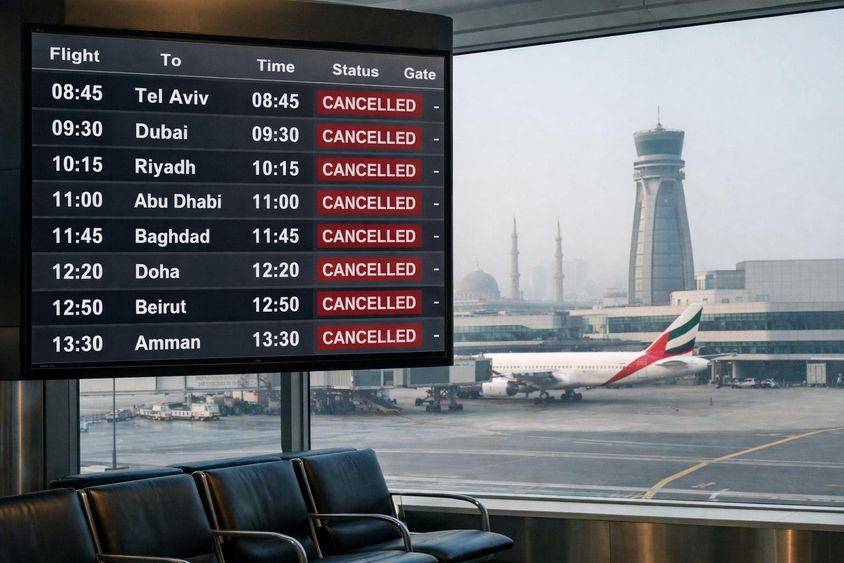
Air Transport Chaos in the Middle East: Airlines Cancel Dubai Flights
The aviation sector in the Middle East is facing unprecedented disruptions in recent days. Due to a developing military conflict in the region, operations at several key aviation hubs have become restricted, and the airspace of numerous countries is partially or completely closed. This situation has left tens of thousands of passengers stranded at airports or forced to make unexpected route changes. The uncertain circumstance particularly affects the transfer hubs in Dubai, Doha, and Abu Dhabi, which are usually nodes in one of the busiest air transport networks in the world.
Most international airlines have implemented swift measures, by canceling or temporarily suspending flights, or using alternative routes to avoid deemed dangerous airspace. The next days and weeks could be crucial for the stability of global air transport.
European airlines are also halting their flights
Many European airlines announced significant restrictions within the first days of the conflict. Greek airline Aegean Airlines has canceled all flights to Tel Aviv, Beirut, Erbil, and Baghdad until March 29. Additionally, the company has suspended its flights to Dubai until March 28, and its Riyadh flights until March 14.
Latvian carrier Air Baltic made similar moves: the airline canceled all flights to Tel Aviv until March 28, while its Dubai flights will not operate until March 30.
Canadian airline Air Canada took even longer precautions, halting flights to Tel Aviv until May 2, while canceling Dubai flights until March 28.
Spanish carrier Air Europa also responded to the situation by suspending all flights to Tel Aviv until March 20.
Air France and KLM announced significant restrictions as well. Air France canceled its flights to Tel Aviv and Beirut until March 15, while its flights to Dubai and Riyadh are not operating until March 14. For KLM, its Riyadh and Dammam flights are suspended until March 14, Dubai routes are canceled until March 28, and Tel Aviv is omitted from the entire winter schedule.
Asian airlines retreat cautiously
Asian airlines also responded cautiously. Hong Kong's Cathay Pacific canceled all its flights to Dubai and Riyadh until March 31.
Japan Airlines has suspended flights between Tokyo and Doha. Flights departing from Tokyo will not operate between February 28 and March 21, while Doha-Tokyo flights remain halted until March 22.
Malaysia Airlines has entirely suspended its flights to Doha until March 20.
American carriers impose restrictions
American airline Delta has also reacted to the region's instability. The New York to Tel Aviv flights will not operate until March 31, while flights from Tel Aviv to New York remain canceled until April 1.
Middle Eastern airlines operate on reduced schedules
Regional airlines chose different strategies. Dubai-based Emirates has not entirely ceased operations but has introduced significantly reduced schedules. This means certain flights continue, but the network's capacity is much lower than usual.
Abu Dhabi center Etihad Airways also switched to restricted operations. The company has restarted a limited number of commercial flights between Abu Dhabi and several key international destinations.
Qatar Airways is also operating with reduced schedules. The airline launches and receives a limited number of flights at Doha airport after receiving a temporary permit from the Qatari civil aviation authority.
Several airlines announced full regional shutdowns
Some airlines not only canceled specific flights but suspended their entire regional network.
Pegasus Airlines canceled all its flights to Iran until March 28. Additionally, flights to Iraq, Amman, Beirut, Kuwait, Bahrain, Doha, Dammam, Dubai, Abu Dhabi, and Sharjah will not operate until March 23.
Saudi Arabian Saudia Airlines suspended flights to Amman, Kuwait, Abu Dhabi, Doha, and Bahrain until March 12. Moscow and Peshawar-bound flights will be suspended until March 16.
Turkish Airlines canceled flights to Iran until March 12, while flights to Iraq, Syria, Lebanon, and Jordan will not operate until March 13.
One of Europe's largest aviation groups also ceased its flights
The Lufthansa Group, which includes several European airlines, has also implemented significant restrictions. Flights to Tel Aviv are halted until April 2, while Beirut and Dubai flights will not operate until March 28. Tehran flights remain suspended until April 30, while flights to Amman, Erbil, Dammam, and Abu Dhabi will not commence until March 15.
Central and Eastern European airlines' decisions
Polish airline LOT also reacted to the situation. Its Dubai flights are canceled until March 28, and its Tel Aviv flights will not operate until March 31. Riyadh flights are suspended until March 24, while flights to Beirut will not operate between March 31 and April 30.
Italian ITA Airways has suspended its Tel Aviv flights until April 2, while its Dubai flights are canceled until March 28.
Wizz Air made one of the strictest decisions. The airline suspended flights to Israel until March 29. Flights to Dubai, Abu Dhabi, Amman, and Jeddah with European departures will not operate until mid-September.
Airspaces avoided for safety reasons
Several airlines not only canceled flights but avoid entire airspaces. Finnair announced it would not fly over Iraq, Iran, Syria, and Israel's airspaces. However, it has initiated at least one flight towards Muscat to bring passengers home, with plans for additional similar flights.
Uncertain weeks ahead
The actions of the airlines highlight how sensitive global aviation is to geopolitical tensions. Dubai and other major airports in the region are among the world's most important transfer points under normal circumstances; hence disruptions affect not only the Middle East but also Europe, Asia, and North America.
In the coming weeks, everything depends on whether the situation in the region stabilizes and whether crucial airspaces are reopened. Until this happens, passengers must prepare for flight cancellations, longer detour routes, and significant schedule changes.
The Dubai airport and surrounding hubs have not completely stopped their operations, but the current situation clearly shows how vulnerable international air transport is when a sudden conflict develops in a strategic region. The most important advice for passengers now is to always check the current status of their flight before departure, as schedules can change even on an hourly basis.
If you find any errors on this page, please let us know via email.


