Dubai's 'The Loop' Redefines Urban Mobility
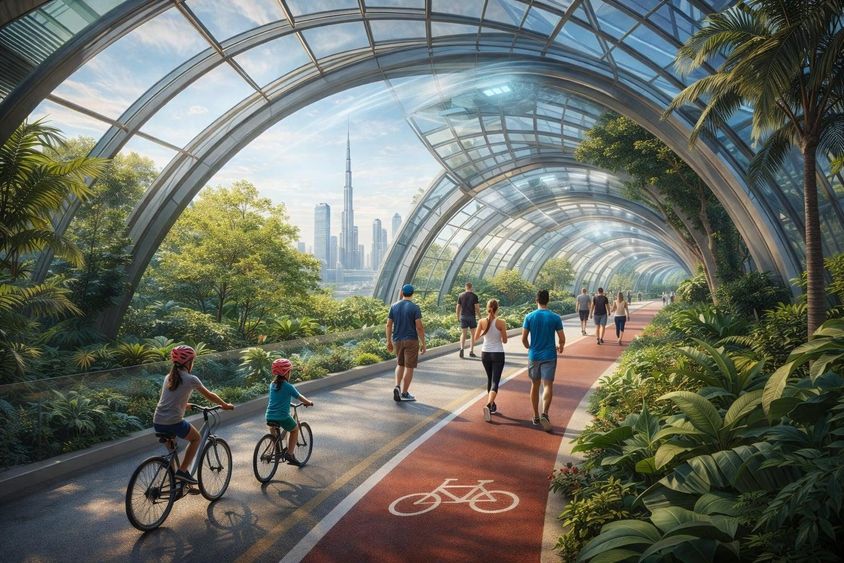
The City of the Future Revolutionizes Movement with 'The Loop' Project
Dubai has once again envisioned what others hardly dare to imagine. They plan to build a 93-kilometer-long, enclosed, climate-controlled pedestrian and bicycle corridor, designed to be usable year-round, even in the extremely hot summer months. The project called 'The Loop' is not just a technological feat but another example of how a desert metropolis can become a global leader in sustainable, human-centric urban planning.
What is 'The Loop'?
' The Loop' is an enclosed, climate-controlled corridor system that is planned to stretch across the city of Dubai, covering approximately 93 kilometers. The goal is for residents and visitors to be able to move about comfortably, safely, and sustainably, whether on foot or by bicycle, regardless of the weather.
The concept is that daily commuting or recreation should not only be associated with driving and air-conditioned shopping malls, but physical exercise and an active lifestyle should also play a central role in city life. This is particularly important in a city where the temperature often exceeds 45 degrees Celsius in the summer months, and the humidity can also be extremely high.
Why is this project revolutionary?
Dubai's climate conditions fundamentally do not favor outdoor physical activities. Anyone who has visited the city in July or August knows that even a few minutes of walking can be extremely exhausting. 'The Loop' aims to overcome this challenge by providing a continuously climate-controlled environment where both the temperature and humidity are regulated.
The enclosed corridor will also feature vegetation, which not only enhances the visual experience but also improves air quality. The project's goal is not just to be functional infrastructure but to be an experience-oriented community space where people enjoy spending time, meeting, exercising, or just walking.
The Intersection of Technology and Sustainability
During the design of the project, special attention is given to operating with the smallest possible ecological footprint. The energy supply will be partly provided by renewable sources — such as solar panels — while water usage will be complemented by recycling systems, and artificial intelligence will be used to optimize lighting, air circulation, and maintenance processes.
Thus, Dubai not only caters to the modern lifestyle but also demonstrates how the cities of the future must simultaneously adapt to climate change and enhance the quality of life.
Who is 'The Loop' for?
The target audience is extremely broad. For those who wish to cycle to work or walk comfortably without needing a car, 'The Loop' is an ideal choice. Meanwhile, those who exercise as a hobby, run, or walk — whether early in the morning or late at night — will also enjoy it.
For tourists, it can be another attraction that shows how Dubai can connect innovation with livability.
Connection to Other Developments in the City
' The Loop' is not an isolated project but part of Dubai's long-term urban and sustainability strategy. The city leadership has been working for years to reduce transportation emissions, increase the proportion of pedestrian and bicycle infrastructure, and enhance energy efficiency through smart city developments.
The project integrates organically into the Dubai Urban Master Plan 2040 vision, which aims for 80% of the city's residents to reach the nearest green area or public transport hub within five minutes.
Why does this matter globally?
While cities in other parts of the world often struggle with overcrowding, smog, and traffic chaos, Dubai seeks solutions that are sustainable in the long term, serving the comfort, health, and environmental needs of people at the same time. 'The Loop' could even serve as a model for other large cities, where climate change and population growth demand new ways of thinking.
Final Thoughts
' The Loop' project again proves that Dubai is not just a city of skyscrapers and luxury cars but one of the leading laboratories of future urban planning. A place where desires are not constrained by norms, and the pace of development is defined by possibilities.
This 93-kilometer climate-controlled route is not just a new form of transportation — it is also a symbol of a new mindset. It is a city that has been able to redefine what daily movement means, how it can be enjoyable, healthy, and environmentally friendly — even if you are in the middle of the desert.
If you find any errors on this page, please let us know via email.


