Dubai's Rainy Road Risks: Stay Alert!
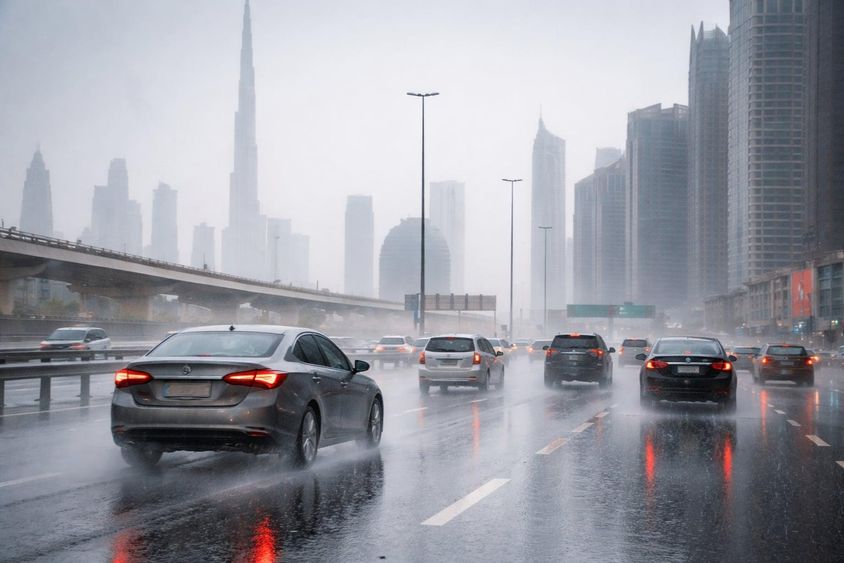
When Cars Fail to Stop - Rain, Grip, and Hidden Risks on Dubai Roads
In the United Arab Emirates, many drivers tend to believe that rain does not pose a significant challenge to traffic. The roads in Dubai and the surrounding emirates are generally of high quality, traffic is well-organized, and the infrastructure is modern. Therefore, it's particularly dangerous when the weather suddenly changes, and the usual conditions become uncertain. Based on recent experiences, more and more drivers report that during or immediately after rain, vehicle braking becomes unpredictable, and the usual responses do not work.
Even seemingly dry roads can be hazardous
One of the biggest problems is that after rain, roads often appear deceptively dry. Much of the water disappears from the surface, but a thin, almost invisible layer remains. This film layer drastically reduces grip, especially when tires are not new.
Rain is a rare occurrence on Dubai roads, so dust, oil, and other debris often accumulate on the road surface. When it starts to rain, these substances mix with water to create an extremely slippery layer. This phenomenon is most dangerous during the first rains, as this is when the most deposits accumulate.
Drivers often react late in these situations, because the appearance of the road does not reflect real grip conditions. This is why rear-end collisions often occur, when one vehicle is braking, but the one behind cannot stop in time.
Functioning of braking systems in wet environments
Many people think that in such situations, the brakes fail, but the reality is more nuanced. In most cases, it's not a complete brake failure, but the combined effect of several factors that reduces braking efficiency.
In wet conditions, a thin water layer can form on the brake discs. This layer can delay contact between the brake pads and the disc, resulting in braking starting not immediately, but after a few tenths of a second. At first glance, this seems insignificant, but at high speeds, even this small delay can mean several meters of braking distance.
Additionally, the anti-lock braking system in modern vehicles behaves differently in such conditions. The ABS aims to prevent wheel lockup, but it activates more frequently on wet roads. In such cases, the driver may feel vibration on the brake pedal, which might scare many, even though the system is actually helping to maintain control.
The role of sensors and electronics
Most modern cars are equipped with advanced electronic systems that continuously monitor the vehicle's condition and road conditions. ABS sensors, for example, measure wheel speed, and based on this data, adjust the braking force.
If these sensors are dirty, worn, or damaged, the system cannot provide accurate data. In wet conditions, water can further worsen the situation, resulting in delayed or uneven braking. This is especially true for older or improperly maintained vehicles.
In Dubai, many cars operate in extreme heat, which already stresses the components. If rain-induced moisture is added, weak points in the system may appear more easily.
The crucial role of tires
Braking efficiency is determined not only by the braking system but also significantly by the tires. If the tires are worn, grip drastically decreases, especially on wet roads.
Tread depth is crucial, as it channels water away between the tire and the road. If the tread is too shallow, a phenomenon known as aquaplaning can occur, where the tire does not adequately contact the asphalt. In such cases, the vehicle becomes virtually unmanageable, and braking is nearly ineffective.
Many drivers in Dubai postpone tire replacement until they are in a critical state. This may not necessarily pose a problem in dry conditions, but in rain, it immediately becomes dangerous.
Increased braking distance and reaction time
The combined effect of rain and reduced grip significantly increases braking distance. This means that a vehicle at the same speed can only stop over a much longer distance than in dry conditions.
The problem is that most drivers do not take this into account. Following distances often remain too short, and reaction times do not change, whereas the conditions do. This is why the number of minor collisions and rear-end accidents increases on rainy days.
Traffic in Dubai is fundamentally fast and dynamic, which further increases the risk. A sudden brake can trigger a chain reaction, especially in denser urban areas.
What to watch out for in rainy weather
One of the most important pieces of advice is for drivers to increase their following distance. This gives more time to react and reduces the risk of accidents. Additionally, sudden braking and acceleration should be avoided, as they can easily lead to loss of grip.
Checking vehicle condition is also crucial. Regular maintenance of brakes, tires, and electronic systems is not only recommended but essential, especially in an environment where weather can change rapidly.
It's also important for drivers to understand how their cars work. Understanding ABS operation, for instance, can help prevent panic when the system intervenes, and ensure they don't release the brake when they most need it.
The role of awareness in safety
Traffic safety depends not only on technology but also on drivers' attitudes. For many in Dubai, driving is part of everyday life, so it is easy to drive routinely. However, rain breaks this routine and creates new situations.
Drivers who think ahead, check their vehicles, and adapt to conditions can significantly reduce risks. For others, even a seemingly insignificant weather change can have serious consequences.
During the upcoming rainy periods, it is especially important that everyone drive more consciously. It's not enough for the car to be technically sound – driving style must also adapt to changing conditions. While Dubai's modern roads forgive much, the laws of physics cannot be defied.
If you find any errors on this page, please let us know via email.


