When Development Meets Nature Conservation
When Development Meets Nature Conservation
For many, the United Arab Emirates is synonymous with rapid development, iconic buildings, and grandiose projects. One of the most well-known examples of this is Dubai, where the cityscape is constantly changing, and innovation is present in almost every field. Therefore, it's particularly noteworthy when a leader decisively says no to a new development—not for economic reasons, but in defense of nature.
A decision like this was made in the emirate of Sharjah, demonstrating that sustainability is not just a communication tool but can be a real compass shaping a country's future.
A Beach That Means More Than Just Space
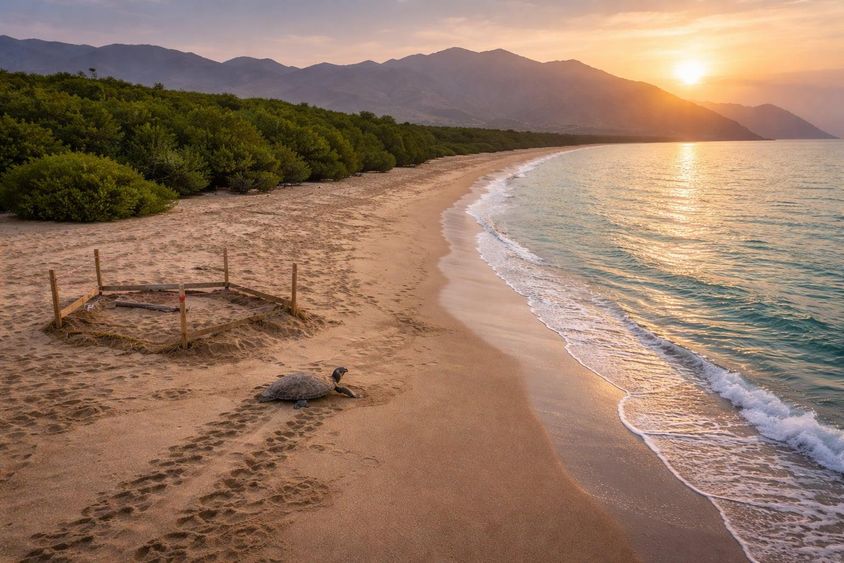
At first glance, Kalba Beach may seem like just another beautiful stretch of coast along the Arabian Gulf. However, this place is much more: it is part of a highly sensitive ecological system that plays a key role in the survival of several endangered species.
Close to the beach is the Khor Kalba Nature Reserve, home to one of the country's oldest mangrove forests. This habitat is not only outstanding in terms of biodiversity but also provides natural protection for coastal ecosystems.
The special significance of Kalba Beach lies primarily in being an important nesting site for the critically endangered hawksbill turtle. Additionally, it is the only known breeding site for an extremely rare bird species that occurs exclusively in this region.
The Warning Behind the Numbers
Scientific observations clearly indicate that disturbing natural habitats has already had serious consequences. The number of regular turtle nestings has drastically decreased over the past decades.
While several nesting events were documented annually on this five-kilometer stretch of beach in the past, in recent years, only a few cases have been reported. In some years, only a single nesting was registered.
This trend is not unique but part of a global problem. Currently, only a few thousand female individuals of this species are capable of reproducing worldwide, making the population particularly vulnerable.
Why Is a Hotel a Threat?
Many initially do not understand why a modern, ecologically designed hotel would pose a problem in such an area. However, the answer is more complex than it first appears.
Sea turtles are extremely sensitive to environmental changes. Even artificial light is enough to disturb their egg-laying cycles. Noise, human presence, and vibrations from construction further diminish their survival chances.
A poorly planned development can set back a population for many years, even decades. And since these animals have long life cycles, regeneration is an extremely slow process.
The Perspective Behind the Decision
Turning down development proposals conveys a clear message: not every area is suitable for economic utilization, and not every investment serves long-term interests.
This perspective is particularly interesting in a region where economic growth is often a top priority. Nevertheless, this decision shows that there is a boundary that must not be crossed.
Natural resources represent a common value and are not only important for one generation. Preserving them is not an obstacle to development but one of its fundamental conditions.
The Role of Protected Areas
The establishment of the Khor Kalba Reserve was already an important step in preserving the region's ecological balance. The nearly 5000 square kilometer area provides a refuge for many species.
Such conservation areas are not only important from a wildlife perspective but also for human communities. They help maintain the stability of coastal ecosystems, reduce erosion, and contribute to mitigating the impacts of climate change.
Recently, other coastal areas have also been officially declared protected, indicating that decision-makers are thinking in a long-term strategy.
Balancing for the Future
The question is not whether to develop but how to do it. Finding a balance between rapid economic growth and environmental sustainability is one of the greatest challenges today.
Dubai's example shows that modern infrastructure and innovation can go hand in hand with sustainable solutions. At the same time, it is clear that in certain locations, the best decision is to leave them untouched.
This is not a step backward but a conscious choice.
The Responsibility of Future Generations
These decisions go beyond the present. They are about what kind of world we leave for the next generations. A world where every stretch of coast is built-up and valued solely for economic reasons, or one where untouched natural habitats still exist.
Preserving Kalba Beach sends a clear message: development cannot mean sacrificing nature. In fact, real development lies in being able to protect what is irreplaceable.
This decision is not just about a beach. It's about a mindset that can define the future of the entire region in the long run.
If you find any errors on this page, please let us know via email.


