What's Behind Dubai's Gold Price Drop?
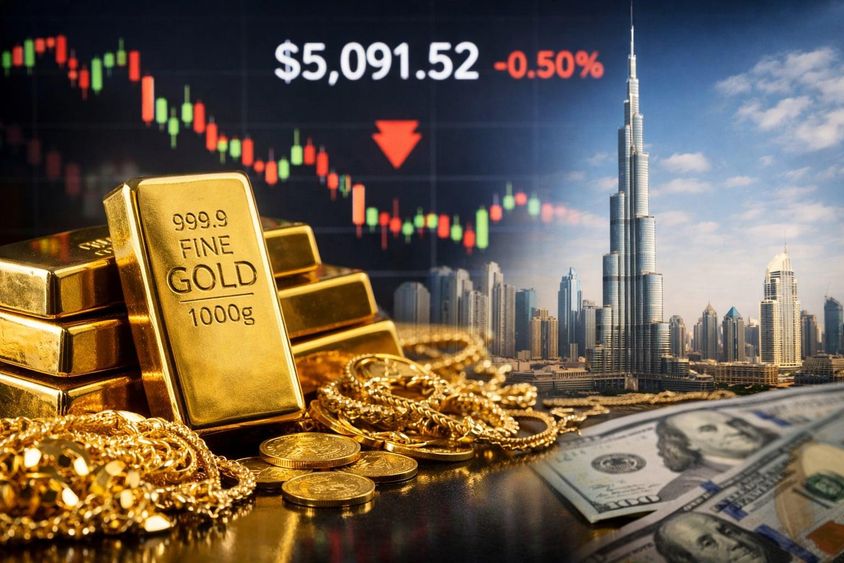
Gold Prices Drop in Dubai: What's Behind It?
In recent days, the price of gold has shown a slight decline in Dubai markets, which surprised investors and buyers who have grown accustomed to continuous price increases in recent times. At the start of trading on Friday, the price dropped by more than two dirhams per gram, which, while not a dramatic change, is an important indicator of international financial trends. The main factors behind this are shifts in global financial market sentiment, the strengthening of the US dollar, and expectations related to interest rate policies.
Dubai's gold market is particularly sensitive to global market trends, as the city is one of the largest gold trading hubs in the Middle East. Tourists, investors, and local buyers all closely watch price movements, as gold is considered a luxury item, an investment tool, and a cultural value.
Current Price Trends in the Dubai Market
At the beginning of Friday's trading, the price of 24-karat gold hovered around 615 dirhams per gram, which is lower than the previous day's closing value. Other types of gold also showed declines. The price of 22-karat gold was approximately 569.5 dirhams, 21-karat gold was 546 dirhams, and 18-karat gold was around 468 dirhams per gram. Even lower purity, such as 14-karat gold, experienced a price drop.
A similar trend can be observed in the global market. The spot gold price stood at just under $5,100 per ounce, which also indicates a slight decrease. While this movement is not considered significant, it demonstrates that the market is currently seeking a direction amid uncertainty.
Impact of Dollar Strengthening on Gold
One of the main drivers of gold price changes is the exchange rate of the dollar. When the US currency strengthens, it generally puts pressure on the precious metal. The reason is simple: gold priced in dollars becomes more expensive for investors paying with other currencies, reducing demand.
In recent days, several factors have supported the strengthening of the dollar. Economic data indicated that certain sectors of the US economy remained resilient. This prompted some investors to reassess the expected pace of interest rate cuts.
If the market perceives that interest rates may remain high for a longer period, it strengthens the dollar. A strong dollar typically exerts downward pressure on gold prices.
Role of Interest Rate Expectations in the Precious Metal Market
Gold holds a unique position in the financial world as it does not pay interest or dividends. This means that when interest rates are high, many investors turn to assets that provide regular returns.
Recently, the market has been increasingly skeptical about swift interest rate cuts. Concerns about inflation persist, and several economic indicators suggest that monetary easing may be slower than previously thought.
This changing expectation has increased bond yields, putting further pressure on gold. When bonds offer higher returns, investors often shift their capital into these assets.
Natural Correction Following Record Prices
Gold prices have surged close to historical highs in recent times. Global uncertainty, inflation fears, and geopolitical tensions all contributed to the price surge.
When an asset rises this quickly, a natural correction often follows. This does not necessarily indicate a trend reversal but is rather part of market rebalancing.
In Dubai's gold market, prices have become more volatile in the short run. Traders and investors often wait during such times to see how the global economic environment will evolve.
Geopolitical Tensions and Gold's Safe-Haven Role
Although the price of gold has dipped slightly, the geopolitical situation continues to provide strong support for the precious metal. Tensions in the Middle East, particularly conflicts surrounding Iran, continue to create uncertainty in financial markets.
In such an environment, gold traditionally serves as a safe-haven asset. When investors perceive the global situation as riskier, they often transfer a portion of their capital into gold.
This phenomenon helps prevent significant price drops, even when other factors are exerting downward pressure.
Indirect Effects of Rising Oil Prices
The geopolitical situation in the Middle East impacts not only gold but also the oil market. Attacks on energy infrastructure and supply risks have led to rising oil prices.
Increases in oil prices often create inflationary pressure worldwide. When energy becomes more expensive, it impacts various industries through increased transportation costs.
Long-term inflation growth could benefit gold, as many investors view the precious metal as a hedge against inflation.
Dubai's Role in Global Gold Trading
Dubai is one of the world's most important gold trading centers. Known for its famous gold markets, modern trading systems, and favorable business environment, a significant portion of the precious metal passes through the city.
The city is important not only as a jewelry market but also as an investment hub. Banks, traders, and investors continuously monitor global trends, as Dubai prices react quickly to changes in the world market.
For tourists, gold remains an attractive purchase option, especially when prices dip in the short term.
What Are Investors Watching Now?
In the coming period, several factors could influence gold price developments. The most important among these are monetary policy, inflation trends, and geopolitical events.
If interest rate cuts arrive slower than expected, it could continue to exert pressure on gold. However, global uncertainty could give new momentum to the precious metal at any time.
For the Dubai market, regional stability and oil price trends are particularly important. If energy prices remain persistently high, the inflationary impact could ultimately boost demand for gold.
Short-Term Decline, Long-Term Uncertainty
The current decline in gold prices does not necessarily signify a long-term trend reversal. It reflects a period where the market is reassessing economic prospects.
The price movements seen in Dubai trading highlight how closely intertwined the local market is with the global financial system. Dollar strengthening, changes in interest rate expectations, and geopolitical events all impact how much a gram of gold is worth in the city's jewelry stores and trading centers.
In the coming weeks, investors' focus will primarily be on international economic data and geopolitical developments. These factors will determine whether gold prices continue to fall, stabilize, or rise again.
If you find any errors on this page, please let us know via email.


