Understanding UAE's Emergency Alert System
How the UAE's Emergency Alert System Works and Why Not Everyone Receives Notifications
The Foundation of Modern Safety: Targeted Alerts, Not Mass Noise
In recent years, the United Arab Emirates has placed significant emphasis on enhancing the safety of its citizens not just through physical protection but also through intelligent communication. A key element of this initiative is the national emergency alert system, which becomes particularly visible to many during military or security events in the region.
However, many are baffled by one phenomenon: why doesn't everyone receive alerts at the same time? Why do some phones sound loud alarms while others remain completely silent, even in the same city, such as Dubai?
The answer is not a technical error but a result of careful planning.
Geo-location Based Operation: The Essence of the System
One of the most important features of the emergency alert system is that it delivers notifications not on a national level, but based on precise geographic locations. This means the system can determine which areas are directly impacted by an event—such as a potential air threat—and sends warnings solely to people in those specific locations.
This approach serves two crucial purposes. First, it avoids unnecessary panic in areas where there is no real danger. Second, it ensures that those who are truly affected receive swift and relevant information.
This is particularly important in a dynamic and densely populated city like Dubai, where a difference of just a few kilometers can mean a situation no longer poses a direct risk.
Why Doesn't Everyone Receive Notifications?
It follows from the system's operation that alerts are not uniform. If someone does not receive a notification, there can be several reasons.
One of the most common reasons is simply that the person does not reside in the affected zone. As the system tailors the alert to the location of the threat, those outside of this area will not receive a warning.
Another important factor is the current state of the device. If a phone is connected to a different cell tower or is temporarily unreachable on the network, it may not receive the alert.
Additionally, user settings can also play a role. If someone has disabled emergency notifications, the system cannot deliver the message to them even if they are in the affected area.
The Sounds We Hear—and Misunderstand
Recently, many residents reported hearing explosive sounds without receiving any official alert. This has raised further questions about how the system operates.
It's important to understand that sound travels differently than alert systems. The sound from an aerial event can reach several kilometers away, so people who are not actually in danger might hear it.
However, this does not mean that the system is malfunctioning. Quite the opposite: the absence of an alert indicates that the area in question is not part of the direct risk zone.
Updated Alert Protocol: Adapting to Everyday Life
The UAE has recently updated how its alert system operates, with particular attention to sound signals. The aim of the changes is to better align warnings with the time of day and prevent undue stress, especially at night.
The system currently operates in two different modes.
During the day, from 9 AM to 10:30 PM, strong, audible alert sounds indicate danger, followed by a standard message at the end of the warning.
At night, a more subtle approach is used. Alerts are issued and concluded with simple text notifications, without loud sirens.
This change demonstrates that the system takes into consideration both security and social aspects.
What to Do in Case of an Alert?
When the system issues an alert, it is not a suggestion, but a specific instruction. The warnings generally specify clearly what actions to take.
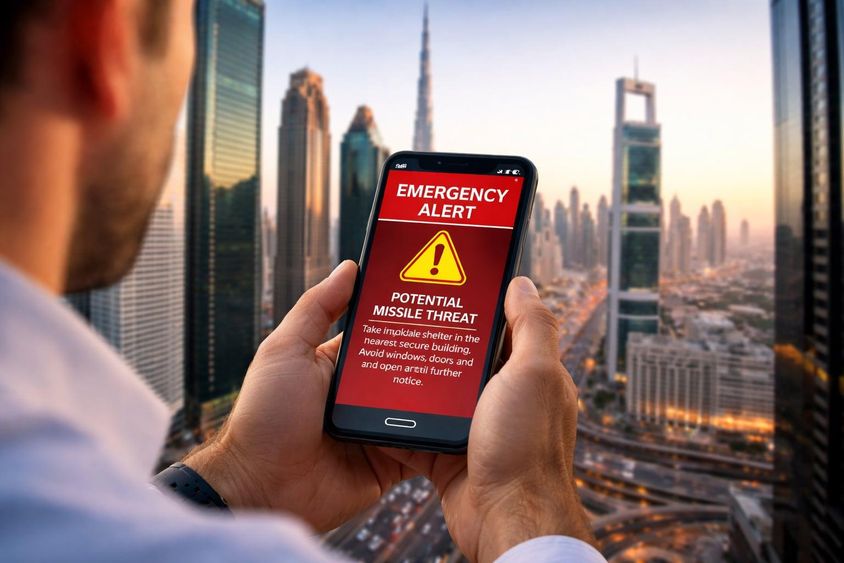
The most common instruction is for affected individuals to immediately seek shelter in the nearest safe building. Windows, doors, and open areas should be avoided as they can increase the risk of injury.
Authorities also emphasize that official communication channels should always be followed. Information spreading on social media is often inaccurate or misleading.
The Philosophy Behind the System
The emergency alert system is not just a technological solution but a kind of mindset. The goal is not to continuously warn everyone but to deliver the right information at the right time to the right place.
This precision is particularly crucial in a region where the security situation can change quickly. With this approach, the UAE strikes a balance between safety and the continuity of everyday life.
What Does This Mean for Everyday Life in Dubai?
For Dubai's residents, the system operates like an invisible safety net. Most days pass eventlessly, while in the background, an infrastructure is in place that can immediately respond to any threat.
If someone doesn’t receive an alert, it's actually good news. It means there is no direct danger in their environment.
This system helps maintain the city's stability and functionality even during periods when tensions are present in the region.
Summary: Silence Is Also Information
Understanding the operation of the emergency alert system helps alleviate uncertainty. Not every absence of an alert signifies a problem, and not every sound indicates a threat.
The system's essence lies in precision and relevance. If we receive a notification, it's because it's truly necessary. If not, it's because the system is working accurately.
In this context, silence is not an error but a reassuring sign: the situation is under control.
If you find any errors on this page, please let us know via email.


