Understanding UAE Travel Insurance During Conflict
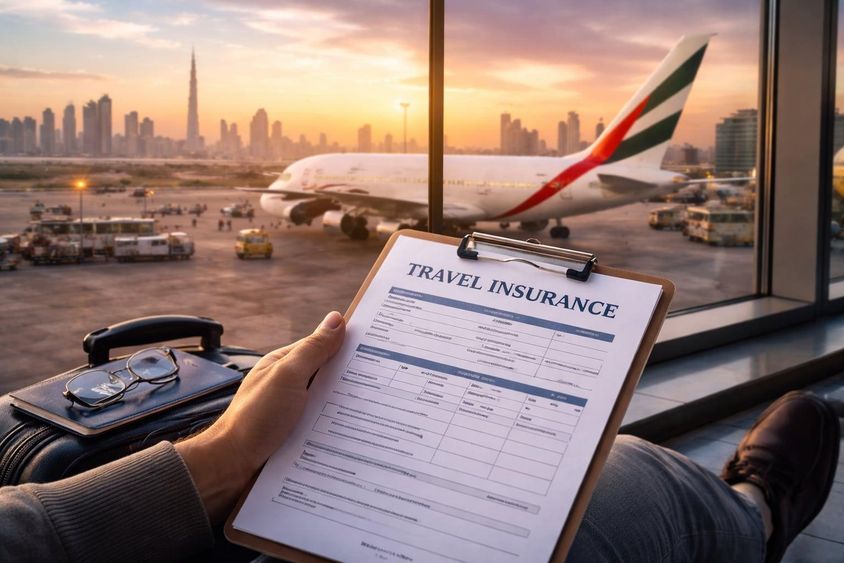
Travel Insurance in the UAE During Conflict – What Does It Really Cover and What Doesn’t?
Interest in travel insurance has visibly increased in recent weeks in the UAE. The military tensions in the Middle East and resulting air travel disruptions have prompted many travelers to revisit their insurance policies or purchase new ones. Travelers have begun to inquire en masse about what exactly their insurance covers, especially in situations where flights are canceled, airspace is closed, or entire travel itineraries are disrupted.
Since the outbreak of conflict, the region has experienced massive air travel disruptions. In a matter of days, tens of thousands of flights in the Middle East have been canceled, causing significant chaos in the travel industry. The UAE’s aviation system—whose primary hub is Dubai—has been particularly sensitive to airspace restrictions. Numerous flights were suspended in the initial days, later gradually resuming operations.
This situation has raised a fundamental question: Does travel insurance cover such problems?
Why Has Interest in Travel Insurance Increased Suddenly?
When conflict arises in a region, travelers naturally become uncertain. During such times, people consider not only the safety of their travel but also what happens to their money if their trip is interrupted or foiled.
Insurance providers operating in the UAE have reported a drastic increase in inquiries related to insurance policies. Travelers have been urgently checking whether they are eligible for compensation for canceled flights or trip interruptions.
However, many have been surprised to find that insurance contracts often do not cover losses directly arising from war or military conflict. This exclusion is included in the basic terms of most international travel insurance.
What Does a Typical Travel Insurance Cover?
Classic travel insurance generally protects several important areas, especially for those traveling abroad.
One of the key elements is healthcare coverage. If a traveler abroad has an accident or falls ill suddenly, the insurance may cover emergency medical treatment, hospitalization, and even repatriation.
In addition, many insurances include trip interruption or cancellation coverage. This might come into play if the trip is halted for personal reasons, such as illness, a family emergency, or another unexpected event.
Travel delays are also included in many insurances. If a flight is significantly delayed, the insurance might cover certain expenses—like accommodation or meals.
A common coverage is for the loss or damage of luggage. If an airline loses a passenger's baggage, the insurance may partially reimburse its value.
Conflicts and Wars are a Separate Category
One of the most crucial and least known aspects of travel insurance is the list of exclusions. These are the cases for which the insurance does not pay.
Most insurance contracts explicitly exclude losses arising from war, armed conflict, military operations, or terrorist acts. This means that if a trip is canceled or interrupted because armed conflict develops in a region, insurers often do not cover the costs.
This can surprise many travelers, especially when entire travel plans collapse due to mass flight cancellations or airspace closures.
In such situations, a significant portion of the costs is often borne by airlines or travel agencies. In many cases, they offer alternative flights, refunds, or new booking options.
What Happens If Flights Are Canceled?
In the current situation, a large portion of travel issues stem not directly from the travelers themselves but from air travel restrictions.
If a flight is canceled or significantly delayed, the primary responsibility generally falls to the airline. In most cases, the airline is obligated to provide an alternative flight or refund the ticket price.
Travel insurance plays more of a supplementary role here. It may cover certain extra costs, but the basic solution is usually provided by the airline.
This is why it’s important for travelers to not only read their insurance policy but also the airline's travel terms.
Travel Insurance Prices Have Remained Stable
Interestingly, despite the current geopolitical tensions, travel insurance premiums in the UAE have not seen significant increases.
According to comparison platforms operating in the insurance market, prices remain within the usual range. While certain destinations might see minor risk surcharges or stricter conditions, the overall market remains stable.
One reason for this is that many factors play a role in determining insurance premiums. These include global travel trends, rising healthcare costs, and insurance claim statistics.
A regional conflict alone does not necessarily change the entire market’s price structure immediately.
Why Is It Important to Read the Insurance Terms?
The current situation has highlighted the fact that many travelers do not actually know the conditions of their insurance contract in detail.
Most insurance policies are lengthy and detailed documents that contain coverages, limitations, and exclusions. Travelers often only start to thoroughly review these when a problem arises.
However, it’s worth understanding exactly the protection offered by insurance before traveling.
It’s particularly important to pay attention to those points that regulate events related to war, political instability, or airspace closures.
Dubai's Travel Market Adapts to Uncertainty
Dubai is one of the world’s most important aviation hubs. Tens of millions of passengers pass through the city's airports annually, so geopolitical situations in the region directly affect the travel industry.
The current conflict has once again shown how sensitive the travel market is to decisions related to airspace and security.
However, it is also evident that the system adapts quickly. Flights are gradually resuming, and travel providers are striving to offer flexible solutions to passengers.
No Dramatic Change Expected in the Long Term
According to insurance experts, even if the conflict drags on for a longer period, an immediate or dramatic price increase in the travel insurance market is not expected.
Insurance premiums are shaped by global trends, not solely by a single regional event.
This means that while the current situation may cause temporary uncertainty for travelers, the insurance market is likely to remain stable.
However, an important lesson for travelers has already become clear: travel insurance does not provide protection for every situation. Therefore, it is essential to thoroughly review the terms before any trip, especially if the destination or route passes through areas where geopolitical tensions may arise.
If you find any errors on this page, please let us know via email.


