UAE Swelters as Temperatures Near 50 Degrees
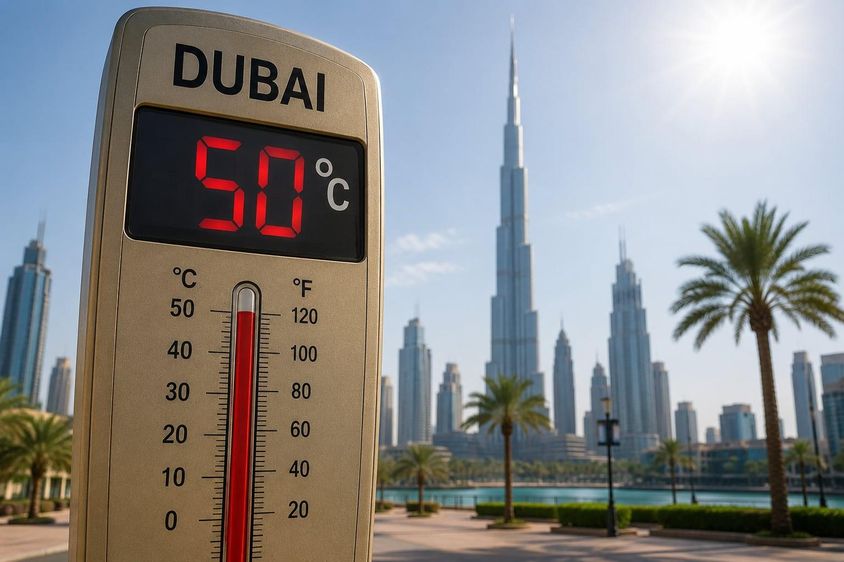
Close to 50 Degrees: Exceptional Heat Recorded in UAE
UAE's summer weather has once again shown how extreme the desert climate can be, with temperatures edging dangerously close to the 50-degree Celsius mark. On June 24, Wednesday, the country's highest recorded temperature was 49.8 degrees Celsius in the Al Dhafra region of Abu Dhabi. According to the National Centre of Meteorology (NCM), this measurement was taken at 1:45 PM. This value alone is a warning sign: the UAE has entered a summer period when the heat not only becomes unpleasant but also requires significant adaptation in daily life.
The current reading of 49.8 degrees is particularly noteworthy because only a few days earlier, on June 20, the highest recorded temperature in the country was 49.4 degrees Celsius in the Sweihan area near Al Ain. This indicates that the heatwave has been gradually intensifying, and temperatures in the country's interior desert regions have been hovering at extreme levels for days. At such values, it is not just a matter of "it's hot" but the increased strain on the body, especially for those working outdoors, commuting, or spending prolonged periods in environments without air conditioning.
Summer in the UAE always poses a serious challenge, yet the data from recent days serves as a strong warning even by local standards. The NCM has previously indicated that residents should prepare for several months of intense heat, and in some areas, temperatures may occasionally exceed the 50 Celsius degree threshold. The hottest period usually falls during midday and early afternoon, when solar radiation is at its peak and the ground radiates significant heat back into the air. During these times, the perceived temperature can often be higher than the official thermometer reading, especially if humidity is also a factor.
One of the characteristics of summer weather in the UAE is that, alongside the extreme heat, humidity plays a significant role. In coastal cities like Dubai, high humidity can make the air feel heavier, more suffocating. While the interior desert areas experience dry heat, the coastal regions' humid warmth reduces the effectiveness of the body's natural cooling system, sweating. This can be particularly uncomfortable in the evenings and early mornings when temperatures drop slightly, but humidity rises.
Official weather forecasts indicate that showers and thunderstorms may still occur in the eastern and mountainous regions of the country, while extreme heat prevails in other areas. This might seem contradictory at first, but in UAE's summer weather, it is not uncommon for hot, humid, and unstable air masses to facilitate the formation of cumulus clouds in the afternoons, especially near the eastern mountains. On June 24, several eastern regions, including Shawka Road, Al Watan Street, and the area around Wadi Al Helo, reported moderate to heavy rain, while in other parts of the country, the temperature was approaching 50 degrees.
This duality illustrates how varied UAE weather can be even within a single day. In the Al Dhafra region of Abu Dhabi, scorching heat prevailed, while showers, runoff streams, and temporarily cooler air appeared in the eastern highlands. Social media footage showed spectacular rain along several eastern routes, which is a unique sight for many residents during the summer. However, such rains also pose traffic risks as the dry, dusty roads quickly become slippery, and mountain valleys can rapidly experience water flow.
Due to the extreme heat, it is advisable for residents to seriously consider altering their daily routine. During the hottest hours, roughly from noon to four in the afternoon, it is wise to avoid prolonged outdoor activity. Those who can should handle outdoor tasks early in the morning or late in the evening. Fluid replacement during this time is not a luxury but a necessity. The body rapidly loses water and minerals, especially when someone is walking, working, exercising, or using public transport. In the heat, headaches, dizziness, weakness, confusion, and nausea can be warning symptoms.
In Dubai, much of daily life occurs in air-conditioned environments, but this does not mean residents are unaffected by the heat. Walking between metro stations, using parked cars, courier work, the strain on construction workers, or even a short outdoor wait can pose serious challenges. Cars can heat up extremely quickly inside in minutes, so children, the elderly, or pets should never be left in a closed vehicle, even for a very short time.
It is also essential for workplaces and service providers to adapt to the summer conditions. For outdoor work, providing rest periods, shaded areas, cooled rest zones, and access to drinking water is not just a matter of comfort but also a safety issue. In UAE, during the summer months, particular attention is given to restricting midday work as the heat is most dangerous for those doing physical labor. The current reading of 49.8 degrees again highlights that adhering to summer regulations is life-saving.
Globally, extreme weather phenomena are receiving increasing attention. The World Meteorological Organization previously warned that the development of the El Niño phenomenon could impact temperature and precipitation patterns worldwide. The effects of such oceanic-atmospheric processes are not uniform everywhere, but they can contribute to more frequent or intensified extreme weather events in certain regions. In the case of the UAE, summer heat is a natural part of the climate, yet the nearly 50-degree readings still deserve serious attention.
According to NCM forecasts for the coming days, partially cloudy and occasionally humid weather is expected to persist, with convective clouds potentially forming in the afternoons mainly in eastern areas, which could also bring rain. The official forecast for June 25 suggests occasional cloudiness in the eastern areas, overnight and morning humidity, with fog or mist formation possible in some places, while winds may strengthen at times.
The near-record temperature data is not an isolated event but part of a longer, intense summer period. Residents and visitors in the UAE must anticipate that the next few months will be dominated by heat, affecting daily schedules, travel, work, and leisure activities. Dubai, Abu Dhabi, Al Ain, and the country's internal areas will all experience summer differently, but the common point is clear: without conscious preparation, the heat can quickly become dangerous.
The measurement of 49.8 degrees Celsius in Al Dhafra serves as a strong reminder that UAE's summer is not just about sunshine and clear skies but also heightened caution. Those who stay hydrated, avoid the hottest hours, monitor weather warnings, and take their body's signals seriously can navigate this period more safely. In the coming weeks, the question will not be whether it will be hot, but when and where the temperature will exceed the 50-degree threshold.
If you find any errors on this page, please let us know via email.


