Dubai's New Transport Evolution: A Pedestrian Breakthrough
Pedestrian and Cyclist Network to Connect Dubai Neighborhoods
Dubai's transportation system has undergone tremendous development over the past decades. The city’s road network, metro lines, buses, taxis, and water transportation systems now facilitate daily travel for millions of people. However, upcoming developments in the following years will not solely focus on cars or high-capacity public transport. Increasing attention is being given to walking, cycling, and using electric scooters.
The Dubai Roads and Transport Authority has approved a five-year development plan aimed at connecting 25 residential communities with pedestrian pathways, bicycle lanes, and other so-called light transportation solutions by 2030. As part of the program, the surroundings of 63 metro and bus stations will also be transformed.
The goal of the developments isn’t just to build more sidewalks and bicycle lanes. Dubai aims to create an integrated transportation system in which people can comfortably, safely, and preferably without their own car, travel from their homes to the nearest public transport stop.
Easing the First and Last Mile of Travel
One of the biggest obstacles to using public transportation in many cities isn’t the metro or bus network itself, but how passengers get to the stations. This issue is often referred to in transportation planning as the first and last mile of travel.
For example, there may be only a few hundred meters between a residential building and the nearest metro station, but the route might lack a proper sidewalk, shading, or safe pedestrian crossing. In such cases, many prefer driving or taking a taxi, even if most of the journey could be made by metro.
The new plan seeks to change this situation. It will involve creating wider sidewalks, segregated bicycle paths, shaded pedestrian routes, and safer crossings around metro and bus stations. Additionally, there will be bicycle storage, rest areas, passenger pick-up points, and short-term parking zones.
As a result of the developments, residents will find it easier to choose walking, cycling, or using an electric scooter to reach public transport stations from their homes.
Touching 25 Residential Communities
Under the five-year plan, the light transportation infrastructure will be further developed in 25 residential communities. By 2030, there could be a total of 34 areas in Dubai with comprehensive walking, cycling, and electric scooter networks.
Some of the work is already underway. New pedestrian and bicycle routes are being developed in areas like Dubai Marina, Naif, Al Rigga, Al Murar, and Al Muraqqabat. These districts vary in terms of density and transportation characteristics, so developments are tailored to local conditions.
In Dubai Marina’s modern residential and business environment, bike paths connecting waterfront promenades and public transportation stations may play a significant role. In Naif, Al Rigga, Al Murar, and Al Muraqqabat’s densely built streets, however, the creation of safe pedestrian crossings, wider sidewalks, and shaded routes might be particularly important.
The goal in each case is to establish continuous, easily navigable, and safe routes between residential buildings, business centers, markets, metro stations, and bus stops.
Revamping 63 Station Surroundings
A vital part of the plan is transforming the surroundings of 63 metro and bus stations. Not only will the sidewalks leading directly to the stations be improved, but the adjacent streets and junctions will be treated as a unified transport system.
During the revamps, new pedestrian crossings, bicycle lanes, and shaded pathways will be built. Some locations may also see landscaping, rest areas, and improved street lighting. The plans include designated parking spaces for cars, as well as passenger pick-up and drop-off points.
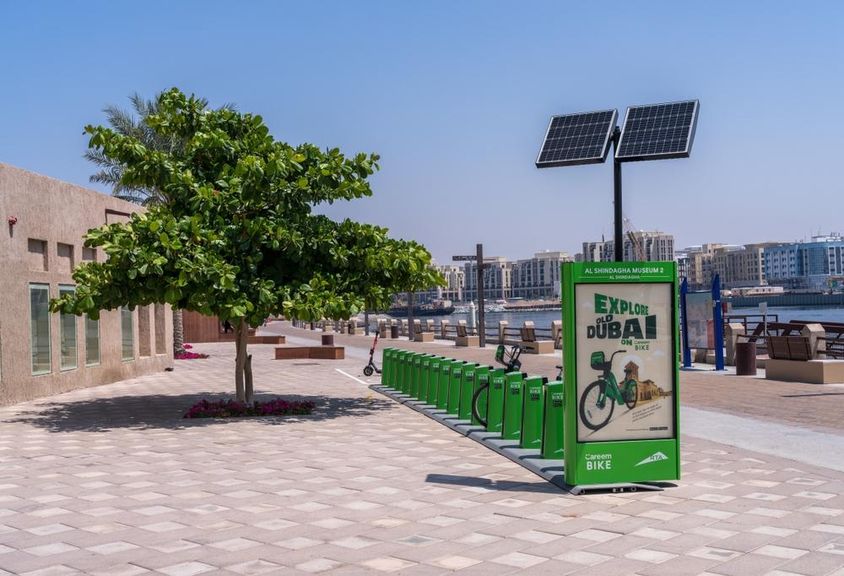
Separate areas may be provided for community bikes and licensed electric scooters. This is significant because it allows passengers to continue their journey with another mode of transport after leaving a metro or bus station, without having to bring their own bike or scooter.
The transportation system is being designed with the needs of people with disabilities and those with mobility limitations in mind. Barrier-free routes, properly designed curbs, ramps, and more easily usable crossings may be part of the developments.
Significant Pedestrian and Cyclist Traffic Already
Transportation data also supports the necessity of these developments. In Dubai, around 342 million pedestrian trips were recorded in 2025. In the same year, there were 57.3 million bicycle trips, and 39.6 million electric scooter trips.
These figures demonstrate that alternative forms of transportation are already crucial to daily life in Dubai. Walking is naturally part of almost every trip since passengers must walk the final section after getting out of a car, metro, or bus.
The use of bicycles and electric scooters is also steadily increasing. They are particularly popular in areas where shorter distances need to be covered between residential buildings, offices, shops, beaches, and public transport stations.
However, the lack of safe infrastructure may hold back those who would otherwise happily choose these modes of transport. Separate bike lanes, well-marked crossings, and shaded sidewalks are not only convenient advancements but also essential in preventing traffic accidents.
Shading is Essential in Dubai
Due to Dubai's climate, developing pedestrian transportation cannot be limited to simple sidewalk construction. In the summer months, high temperatures and intense sunlight can significantly hinder longer outdoor walks.
Therefore, shaded pedestrian routes are a crucial part of the program. Covered or vegetation-shaded pathways can reduce direct sunlight exposure and make station access more comfortable.
The creation of resting areas can also be important. Seating, water-filling stations, and air-conditioned waiting areas along a longer route can be a significant help to the elderly, families with small children, and people with mobility issues.
Landscaping can serve not only aesthetic purposes. Appropriate vegetation can contribute to shading, improve the urban environment, and make pedestrian routes more pleasant.
Building on Experiences from Past Districts
Several districts in Dubai have already undergone similar developments previously. Al Mankhool, Al Qusais, Al Karama, Al Barsha 1, Al Barsha 2, Al Khawaneej 2, Hor Al Anz, Abu Hail, and Al Souk Al Kabeer have already completed or partially realized modifications supporting pedestrian and bicycle traffic.
In these locations, connections between residential neighborhoods and public transport stations were improved, safer crossings were established, and more space was allocated to pedestrians.
The authority has also implemented developments in the surroundings of 37 metro stations. The sites include Mall of the Emirates, Burj Khalifa and Dubai Mall station, Onpassive, Gold Souq, BurJuman, Baniyas Square, Sharaf DG, and Abu Hail station.
During earlier efforts, pedestrian and bicycle routes, transport hubs, and facilities supporting the use of public transport were established. The new five-year program builds on these experiences and already functioning solutions.
Areas are Not Chosen Randomly
The selection of districts and stations to be developed is based on multiple factors. Considerations include the population density of the area, the usage of public transport options, the placement of residential and business areas, and the current state of sidewalks and bike lanes.
Future development plans are also an important consideration. In a rapidly growing residential district, appropriate transport connections may be needed even before the completion of new buildings.
The aim is for pedestrian and cyclist infrastructure not to consist of standalone elements. A short bike lane or a single renovated sidewalk section is less useful if it does not connect to other routes. Thus, Dubai strives to create integrated networks connecting residential communities, business districts, public transportation stations, and important destinations.
Reducing Car Usage for Short Journeys
The long-term goal of the program is to encourage more people to opt for public transit instead of their own cars. However, for this to happen, the entire journey must be comfortable and predictable.
If a resident can safely walk or cycle to the metro station, and then continue in a similar manner from the destination point, there will be less need for a personal vehicle. This could particularly bring about change for short, intra-city trips of a few kilometers.
Reducing car usage can help alleviate traffic congestion, reduce the demand for parking spaces, and improve urban air quality. Walking and cycling can also integrate regular physical activity into daily life.
The significance of cars is not expected to cease because Dubai is a large city where many journeys are still most convenient by car. However, the developments will create opportunities for residents to choose from various transportation modes according to the length and purpose of the journey.
Part of the 2040 Urban Development Plan
The expansion of the pedestrian and cyclist network is linked to the goals of the Dubai 2040 Urban Development Plan. The long-term strategy aims to create an urban environment where residential areas, workplaces, services, and transport hubs are easily accessible.
In Dubai’s future, transportation will not solely mean a system of roads and vehicles. Urban planning increasingly considers entire trips, examining how someone travels from the front door of their home to their final destination.
In this system, the metro, buses, taxis, water transport, walking, cycling, and electric scooters can become complementary options. Passengers can use different modes of transport for various legs of the journey, with safe and easily navigable connections available between transfer points.
Making Dubai's Neighborhoods More Livable
The program impacting 25 residential communities and 63 public transport stations could bring significant changes to Dubai’s daily transportation. The developments won’t be about spectacular skyscrapers or new highways, but rather the smaller details that directly affect people's daily travels.
A wider sidewalk, a shaded walkway, a safe pedestrian crossing, or a well-placed bike rack may seem like small improvements on their own. However, when these elements form a cohesive network, they can significantly enhance urban mobility.
By 2030, plans propose that in several Dubai neighborhoods, it will become simpler to reach metro and bus stations by foot, bicycle, or electric scooter. This could not only encourage public transport use but also create more livable, safer, and sustainable urban environments.
Thus, the next phase of Dubai’s transportation development will not solely be defined by faster roads and larger vehicle capacities. It will become increasingly important for people to safely and comfortably cover the shorter segments of their journeys using their own efforts.
If you find any errors on this page, please let us know via email.