UAE Corals: Survival Lessons for the World
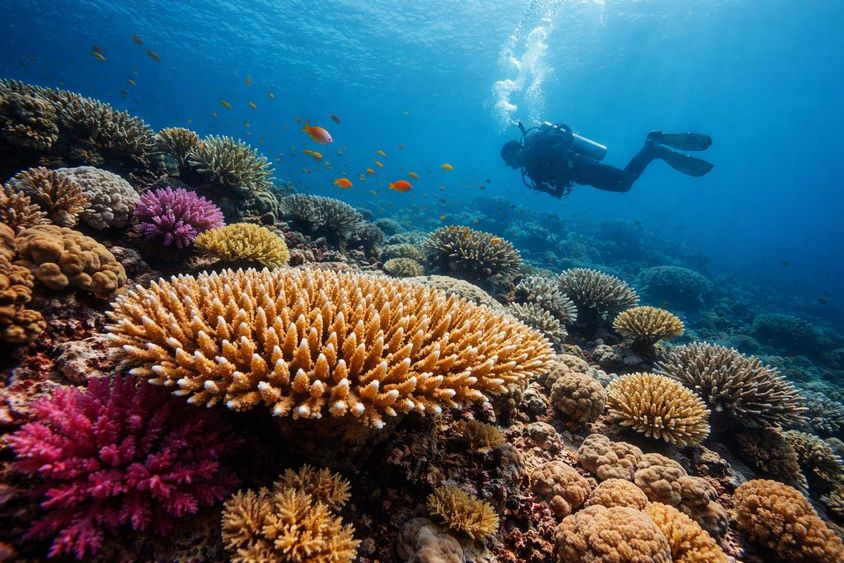
Corals on the Edge of Survival: Why UAE's Example is Special?
The world's coral reefs are under unprecedented pressure. Since January 2023, about 84 percent of global coral ecosystems have been affected by the most extensive coral bleaching event ever recorded. Severe damage has been reported on the coastlines of more than 80 countries, and the situation is so dire that the international alert scale had to be expanded by three new levels. This phenomenon is not merely an aesthetic problem: when corals "bleach," they are actually starving.
Bleaching means that due to elevated water temperatures, corals expel the microscopic algae living in their tissues, which provide up to 90 percent of their energy. When these algae disappear, the coral loses its color and eventually dies if the stress is prolonged. Global warming, causing increasingly frequent and intense heatwaves, triggers a chain reaction in the oceans, with consequences that could determine the fate of coastal ecosystems for decades.
Why isn't this a distant problem for the UAE?
Many tend to associate coral reefs with exotic diving locations that seem far removed from our everyday lives. However, in the UAE, the existence of coral reefs has direct economic and environmental significance. Reefs act as natural wave breakers, protecting coastlines from erosion and storm surges. Additionally, they provide vital habitat for fish populations, which are essential for local markets and restaurants. Marine tourism, attracting millions to the Emirates annually, is also heavily dependent on healthy reefs.
When a reef dies, its consequences quickly spread to the mainland. Coastal protection weakens, fish populations decline, and tourism loses its appeal. Therefore, the state of corals is not an abstract environmental issue but a strategic matter for the country.
The Paradox of Hot Seas
The Arabian Gulf is considered one of the world's warmest marine environments. Summer surface water temperatures regularly exceed 35 degrees Celsius – values that would cause mass coral death in other regions. Yet, numerous coral colonies in UAE waters can survive these extreme conditions.
This contradiction has attracted scientists for years. How is it possible that while reefs in other parts of the world bleach and die, certain corals along the Emirates' coasts resist heat stress? The key lies not only in understanding this survival but also in how this natural resilience can be consciously used to build the reefs of the future.
Heat stress assessment on a national scale
For the first time, a coordinated, nationwide coral heat stress survey was conducted in the UAE. Scientific centers and environmental authorities from various emirates worked together to examine the reefs along both the eastern and western coastlines.
Researchers used a portable device that allows 18-hour tests to be conducted on-site, directly on the reef. During the procedure, the water temperature is gradually raised while measuring how individual coral colonies respond to the stress. The uniqueness of this method lies in the fact that samples do not need to be removed from their natural habitat. Thus, scientists get an accurate picture of which entities can function at extreme temperatures and which are quickly damaged.
The results revealed significant differences between reef systems. In some areas, corals can endure much higher temperature thresholds, while other regions have proven to be more sensitive. This knowledge provides map-like precision indicating where and what strategies should be employed.
Four million corals by 2030
One of the most ambitious goals is to reintroduce four million corals into UAE waters by 2030. This is not simply a reintroduction program. The emphasis is on reconstructing reefs specifically with heat-tolerant individuals.
In light of global warming, it is not sufficient to rely on corals that have survived past heatwaves. Colonies that can withstand upcoming, potentially more intense heatwaves must be selected. The results of heat stress assessments are directly incorporated into restoration projects. The aim is not just to restore the structure of the reef but to strengthen long-term resilience.
Genetics and coral nurseries
The next step is to deepen genetic research. Scientists are investigating which hereditary factors are linked to heat resistance and how these traits can be deliberately maintained or strengthened. Coral nurseries are planned where the selected, resistant individuals will be propagated and raised in a controlled environment.
The portable heat stress measuring system will continue to play a key role in ensuring corals' suitability before any relocation. This scientific thoroughness ensures that restoration is not only spectacular but sustainable.
A laboratory of global significance
UAE waters function as a kind of natural laboratory. If reefs that withstand heatwaves can be maintained and rebuilt here, one of the world's warmest marine environments, it could serve as a guide for other regions worldwide. The genetic and physiological characteristics of corals living here, adapted to extreme conditions, could hold crucial information for global conservation strategies.
The world's most resilient corals might already be living off the UAE's coasts. The question is no longer whether they will survive, but whether we can deliberately and responsibly utilize this resilience for the protection of future reefs.
The story of corals is not just a narrative of an ecological crisis but an opportunity as well. An opportunity to develop a solution through science, strategic planning, and long-term thinking that transcends the region. The UAE's example conveys: even in the most extreme environments, adaptation can exist – but only if it is recognized and supported in time.
If you find any errors on this page, please let us know via email.


