Rainwater Recap: Costly Car Damages in UAE
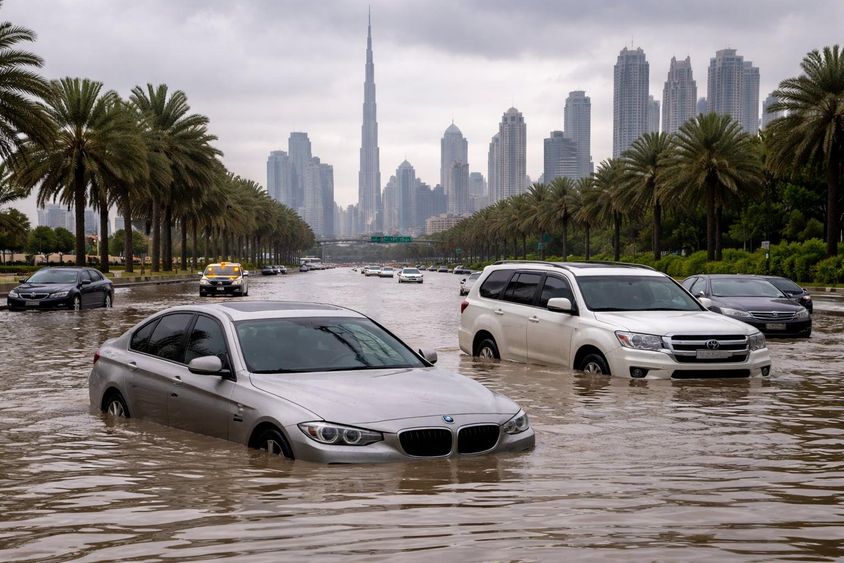
When Rain Leaves a Bill Behind: Cars After Water Damage in UAE
In recent days, heavy rains across several areas in the UAE have created situations that many drivers are simply not prepared for. Parts of streets were submerged in water in a short period, especially in low-lying areas, and social media was flooded with footage of partially or completely submerged cars. The sight in itself is telling, but the real problem often arises days later, in the form of repair costs.
Many hope that insurance will resolve the situation. However, reality is much more complex, and often holds unpleasant surprises.
Not All Insurance is the Same
One of the biggest misconceptions among drivers is that all insurance covers natural damages. This is not true. The so-called third-party insurance only provides coverage for damages caused to others, so if your own car is submerged, the owner can easily be left to pay for the repairs entirely out of pocket.
This becomes especially painful when the damage is not only aesthetic but also mechanical. Water does not discriminate: it enters electrical systems, the transmission, the interior, and, in some cases, the engine.
Comprehensive insurance can put you in a better situation, but even here, there is no guarantee. Insurers often investigate whether negligence occurred. If someone deliberately drove into deep water or attempted to restart the submerged car, the claim could easily be denied.
Water Destroys More Than Just the Exterior
Many think that if the car dries on the outside, the problem is solved. This is one of the biggest misconceptions. Modern vehicles are full of sensitive electronics, sensors, and control units that can malfunction with even a small amount of water.
This is especially true for the newer-generation cars increasingly common on Dubai roads. In these, not only is the engine a critical point, but the entire electrical network. A short circuit or corrosion can appear even weeks later.
Water can also cause severe damage inside the car. Carpets, seats, and sound insulation elements absorb moisture, leading to mold and unpleasant odors. This is not only an aesthetic issue but can significantly devalue the car.
The Most Costly Mistake: Restarting
One of the most common and costly mistakes drivers make is trying to start a submerged vehicle. This is especially dangerous if water has reached the engine's air intake.
This can lead to what's known as hydrolock. This means that water enters the cylinders, where the pistons cannot compress it. The consequence is immediate and severe engine damage, often only treatable by complete engine replacement.
Such a repair can easily reach or exceed tens of thousands of dirhams, especially in premium vehicles.
How Much Does It Really Cost?
Repair costs can vary widely. A milder case, where only drying the interior and changing oils is necessary, can come with relatively lower costs.
However, when electrical systems are involved, the situation quickly changes. Replacing sensors, control units, and wiring harnesses can mean significant expenses. If the engine is also damaged, the final bill can easily reach 15,000–25,000 dirhams or even higher.
This is the point where many drivers realize that insurance does not cover the full cost – or anything at all.
Why Are New Cars More Vulnerable?
Interestingly, technological advancement is not always an advantage in these situations. Newer cars are much more sensitive to water than older models.
The reason is that modern vehicles contain many electronic components: parking sensors, cameras, radars, automatic systems, and various control units. All these are potential failure points in the presence of water.
An older car may be mechanically simpler and, in some cases, easier to repair. A new car is already a complex computer system, where a single malfunctioning component can trigger a chain reaction.
What to Do in Such a Situation?
One of the most important rules: if your car is submerged, do not try to start it. Even if it seems like the water has receded.
The safest solution is to have the vehicle towed to a service center for a thorough inspection. This includes checking the electrical systems, changing fluids, and assessing the engine's condition.
In many cases, quick action can mean the difference between a minor repair and a full engine replacement.
The Future's Lesson
These events highlight that, although UAE's weather often seems predictable, it can sometimes take extreme turns. The infrastructure of Dubai and other cities is continuously developing, but such sudden downpours still present significant challenges.
For drivers, the most important takeaway is caution. It's not worth the risk of driving through deep water, and drivers should always be aware of what type of insurance they have.
Water damage is not just a temporary inconvenience but can be a long-term financial burden. And often, it's not the rain that's the biggest problem, but how we respond to it.
If you find any errors on this page, please let us know via email.


