New Toll Gates Signal Abu Dhabi Expansion
New Toll Gates in Abu Dhabi: Expanding Towards Dubai?
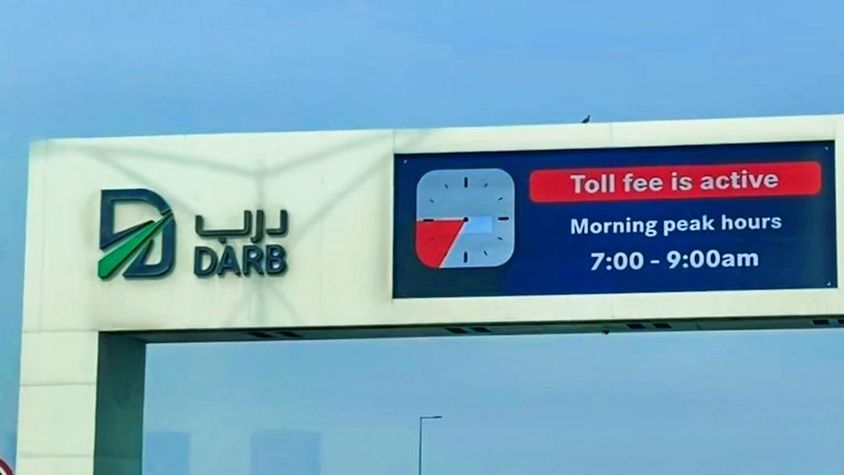
Recently, many drivers have noticed the appearance of new toll gates on one of the busiest routes between Abu Dhabi and Dubai, the E11 highway. Although these gates are not yet operational, they have sparked speculation that authorities plan to expand Abu Dhabi's intelligent toll system.
Observations indicate that such gates have been installed at two different locations: one in the Ghantoot area, near the border between Abu Dhabi and Dubai, and the other near Al Qurm. In both cases, drivers noted that the gates are placed directly on the roadway, unlike previous gates connected to bridges, which could signify a substantial change.
The Operation and Philosophy of the Current System
Abu Dhabi's electronic toll system was launched in 2021 to regulate traffic entering the city. The system previously focused on four key bridges leading to Abu Dhabi Island, where automatic systems monitor vehicle license plates for toll payments.
The logic behind the system is clear: to reduce peak period traffic jams, encourage the use of public transport, and balance traffic distribution. Such traffic management is crucial in a rapidly growing area where commuting between Abu Dhabi and Dubai has long been common.
Why is the New Gate Placement Interesting?
A key characteristic of the newly installed gates is that they are not connected to bridges. This fundamentally could change how the system operates. If tolls are applied not only at city entry points but also on highways, it represents a new level of traffic regulation.
This also means that the system would control not only city entry but also intercity traffic. The E11 route is particularly critical as it connects Abu Dhabi and Dubai, the two most important economic centers.
The presence of new gates thus suggests that in the future, there might be dynamic pricing extending across the entire stretch of road.
What Does This Mean for Everyday Drivers?
An expansion of such a system could significantly impact those who commute daily between Abu Dhabi and Dubai. If tolls apply not only when entering the city but also on the highway, it might increase commuting costs.
However, it is essential to understand that such systems are not solely for revenue. The primary goal is traffic optimization. If tolls are correctly set, they can reduce congestion during certain periods and encourage drivers towards alternative routes or transportation methods.
In the long run, this could save time, which is as important as cost for many.
The Current Pricing Model
Currently, the system charges tolls during peak hours on weekdays. Fees are levied during morning and afternoon periods when traffic is highest. Outside these periods, passage is free, reflecting a balanced approach.
This model allows those who can flexibly arrange their travel to avoid tolls. At the same time, those who travel at fixed times contribute to system maintenance.
The registration system and penalties also aim to track all vehicles and ensure the system operates efficiently.
Uncertainty and Expectation
Currently, authorities have not provided detailed information on when and how the new gates will be operational. This creates uncertainty among drivers, especially those who regularly use the affected routes.
However, it is clear that such infrastructure isn't erected by chance. The installation itself indicates that system expansion is on the agenda, even if the details are not yet public.
Possible Future Directions
Based on current trends, several scenarios are possible. One possibility is the gradual expansion of the toll system onto highways, especially on busy sections.
Another possibility is the introduction of dynamic pricing that adjusts in real time to traffic conditions, already effective in several major cities as a tool for reducing congestion.
It is also possible that specific vehicle categories, such as heavy trucks, will be subject to separate regulations, allowing for further fine-tuning.
Transportation and Strategic Thinking in the Region
Such developments show that Abu Dhabi and Dubai are not only responding to traffic issues but are actively shaping the transportation system. Smart solutions, automated systems, and data-driven decisions play increasingly significant roles.
The connection between the two cities is crucial for the economy, so any step that improves accessibility and reduces congestion can be beneficial for the entire region in the long run.
Conclusion
The emergence of new toll gates on the E11 road clearly signals that Abu Dhabi's transportation system is evolving. While specifics are not yet known, the direction is clear: towards a more complex, flexible, and efficient system.
For drivers, this may require short-term adaptation, but in the long term, it could lead to a more balanced and predictable traffic environment. How this will affect daily travel between Dubai and Abu Dhabi will soon be revealed.
If you find any errors on this page, please let us know via email.


