Iftar Hikes: A Spiritual Escape in UAE
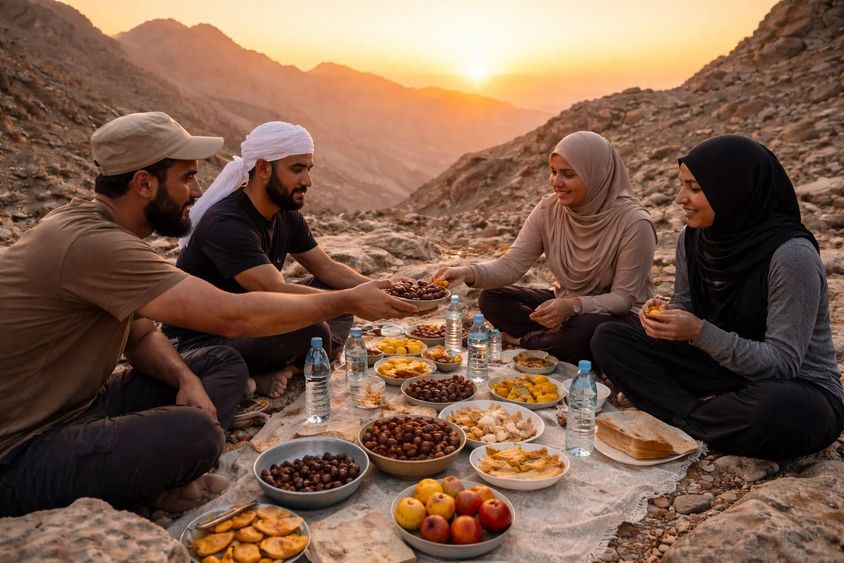
Ramadan Under the Sky: Why Iftar Hikes Attract UAE Residents to the Mountains
The month of Ramadan is a time for reflection, self-discipline, and community. In the UAE, an increasing number of people have chosen a unique form of breaking their fast: not in restaurants or at home, but amidst the mountains, under the open sky. These so-called iftar hikes have become some of the most cherished events among outdoor communities, especially during cooler months when nature provides a true escape from the urban hustle.
These occasions are not about performance, records, or social media photos. Instead, they represent those rare moments when one can step away from daily noise and experience the essence of Ramadan among strangers who become friends.
The Magic of Silence Before Sunset
An hour before sunset, hikers gather at the starting point with backpacks on their shoulders. There are no decorated tables, no loud music, just the slowly cooling air and the silhouette of the mountains. As the time for maghrib draws closer, the group finds itself deep within the mountains. The breaking of the fast is simple: water, dates, a few light bites. Yet many say that this simplicity gives the experience its true power.
The golden light of sunset, the slow coloring of the horizon, and the distant echo of the call to prayer create an atmosphere that no urban environment can replicate. During iftar in nature, silence doesn't signify emptiness but presence. People pay attention to each other, their surroundings, and themselves.
Different Forms, Common Intent
Various hiking communities in the UAE offer programs adapted to Ramadan in different forms. Some start a lighter, moderate-paced hike before sunset, break their fast on the mountain, and return to the city later for a fuller meal. Others prefer to start after the evening prayer around 9 PM, when there is more energy and the first meal has been digested.
Late evening hikes are particularly popular. After 10 PM, many trails come alive: the lights of headlamps snake up the mountainside, groups converse quietly, and the sense of community is almost palpable. At this time, physical exertion can be safely undertaken since participants have already eaten and drunk. However, the focus remains on spiritual replenishment rather than athletic achievement.
Some hikes take place even before suhoor. Participants reach the summit before dawn, have the last bites before the fast begins, and set out back in the light of the rising sun. This form is an especially intense experience, as the quiet dawn and communal meal create a special atmosphere.
Accessibility and Safety Above All
Organizers put great emphasis on making iftar hikes accessible to everyone. These are not extreme climbs but easy or moderately difficult routes that can be completed at an appropriate pace even while fasting. Group sizes are often limited, especially if the descent takes place after dark.
Safety briefings are part of every program. Introductions, route explanations, setting the pace—all form the basis of the shared experience. Participants include not only those who fast but also those who do not fast, yet respectfully adapt to others. They refrain from eating in front of those fasting and ensure that the communal space remains in line with the spirit of Ramadan.
Community Among the Mountains
Many report that the greatest strength of iftar hikes lies in the spontaneous communal experience. When the sun sets, someone passes on dates, another offers a handful of almonds, a third shares their sandwich. Food circulates, as do smiles. Sitting on the mountain ridge, far from city lights, people quickly find a common language.
After a communal prayer, the hike often continues for another hour or two, then concludes with a mountain barbecue or simple suhoor. Most participants feel that these occasions create deeper connections than a traditional restaurant iftar. There's no noise, no rush, no phone distractions—just the sky, the mountains, and community.
Stepping Away from Urban Noise
The UAE's major cities, including Dubai, symbolize the dynamism of modern life—lights, traffic, business meetings, and continuous digital presence define everyday life. However, during Ramadan, many consciously seek places to escape from this rhythm.
Iftar hikes offer exactly this: environments free from visual and sound pollution. In the mountains, one can hear their own footsteps again, feel the movement of the wind, and pay attention to the rhythm of nature. During fasting, it's not an obstacle but a catalyst. Physical hunger and thirst sharpen awareness and give deeper meaning to the evening meal.
Why During Ramadan?
Many ask why people choose to hike during the fasting month. The answer, paradoxically, is simple. Ramadan is not just about abstinence but about self-discipline, experiencing gratitude, and community cohesion. Time spent in nature strengthens all three elements.
The physical challenge—even if moderate—makes one aware of their body's limits. Sharing a meal amplifies feelings of gratitude. The silence of the mountains offers an opportunity for introspection. Many participants say that the simplicity they experience during iftar hikes captures the essence of what Ramadan represents.
A Tradition of the Future?
Although participation during Ramadan may be somewhat lower than at other times of the year, organizers say those who come make a conscious decision. They don't just want to exercise but to experience something that transcends everyday life.
Iftar hikes are slowly becoming a tradition within UAE's outdoor communities. Evenings spent in the mountains, shared dates, the colors of sunset, and the silence after prayer provide an experience that many remember throughout the year. In the pace of modern life, these moments become especially valuable.
Ramadan under the sky is not a spectacle but a return to basics. The meeting of nature, community, and simple meals reminds us that the deepest experiences are often the simplest. Thus, breaking iftar in the UAE mountains is not just a program but a kind of spiritual journey—silently, together, under the open sky.
If you find any errors on this page, please let us know via email.


