How to Spot the Ramadan Crescent Moon
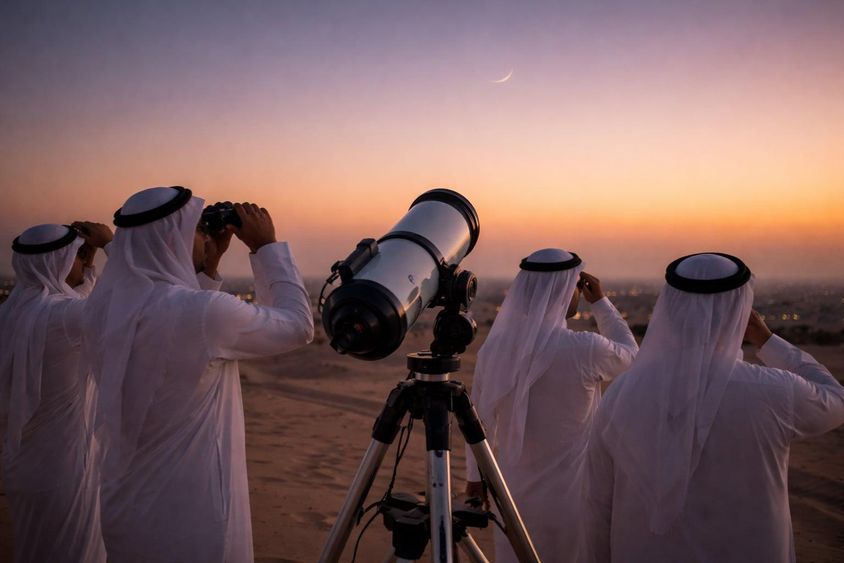
How to Observe the Crescent Moon for Ramadan?
One of the most beautiful and profound traditions in the Islamic world involves determining the start of Ramadan by observing the crescent moon. In the UAE, residents are encouraged once again this year to actively participate in this centuries-old communal practice. The official Moon Sighting Committee will convene on Tuesday evening in Abu Dhabi to decide, based on post-sunset reports, astronomical data, and authentic testimonies, when Ramadan begins. The decision hinges on spotting the new crescent moon in the evening sky.
The process is simultaneously spiritual, communal, and scientific. While modern astronomy can now accurately predict the moon's position, traditional visual observation still plays a significant role. Religious authorities in the UAE emphasize that calculations support but do not replace actual observation.
Why is observing the crescent moon so important?
The Islamic calendar is lunar-based, with each month comprising either 29 or 30 days, depending on when the new crescent moon becomes visible. Thus, the start of Ramadan is not merely a calendar matter but an event tied to specific observation. Spotting the crescent moon is part of a tradition that builds on community involvement and observing celestial signs.
This practice is not merely symbolic. Direct observation strengthens believers' connection to the rhythm of nature, the changes in the sky, and collectively experiencing a moment that determines the mood for the entire month. Ramadan is not just a date on the calendar but the beginning of a spiritual period, for which the announcement itself is a ceremonial act.
At the same time, modern technology now provides precise data on when the moon will be in the proper position in the sky. Astronomical models show the moon's altitude above the horizon, its distance from the sun, and how likely it is to be visible to the naked eye. In the UAE, these data are considered during decision-making, but authentic observations ultimately have the final say.
Where and when should you look for the crescent moon?
The crescent moon should be looked for just after sunset in the western part of the sky. The observation window is short since the moon is very low on the horizon and sets quickly at this time.
Residents in the UAE are encouraged to choose locations with a clear, unobstructed view of the western horizon, such as open desert areas, beaches, or higher ground with less light pollution. City lights can significantly hamper the visibility of the faint crescent moon, especially when the moon is still very close to the sun.
Naked-eye observation is sufficient. Although some use binoculars, authorities warn against the hazards of using telescopes right after sunset due to the sun's glaring light, which poses a risk to the eyes.
This year's forecasts suggest that visibility might be low since the moon will be very close to the sun and extremely low on the horizon. However, this does not mean one should not try—the observation is part of the tradition.
What should you do if you see the crescent moon?
If someone believes they have spotted the crescent moon, it's crucial to immediately inform the official authorities. In the UAE, dedicated channels are provided: phone numbers and online forms are posted through which sightings can be reported.
Incoming reports are always verified. Testimonies are compared with other accounts and astronomical data. An official announcement occurs only if the reports are confirmed to be credible and well-founded. This multi-stage verification ensures the start of Ramadan is announced uniformly and reliably.
Understanding that an individual sighting alone does not mark the beginning of the month is essential. The Moon Sighting Committee makes the final decision after reviewing all available data.
The role of astronomers in the process
While traditional visual observation is crucial, astronomers in the UAE actively participate. With special instruments, high-precision tools, and imaging equipment, they try to document the sky's condition, record atmospheric conditions, visibility factors, and note any detections.
These data help in making a well-founded decision. If scientific calculations indicate the crescent moon is virtually invisible, it can influence the evaluation of testimonies as well. The goal is not for technology to override tradition but to support it.
This duality—the collaboration of faith and science—demonstrates how an ancient practice can adapt to the modern world. The system in the UAE is transparent, structured, and community-based, while also utilizing the latest astronomical knowledge.
The moment of decision
The committee convenes after the Maghrib prayer to discuss the received reports. Testimonies, observatory reports, and international observations all play a role in deliberations. Once the decision is made, it is officially announced to the entire country through official channels.
This announcement is a special moment every year. Families prepare, businesses and institutions adapt to the new period, and the whole community becomes part of a shared beginning. The first day of Ramadan is not just a date but a commonly determined and confirmed time announced based on celestial signs.
Thus, observing the crescent moon is not merely a religious practice but a living tradition connecting the past with the present. Residents in the UAE can actively participate in this process, and even a single glance at the evening sky can contribute to the official commencement of the holy month of Ramadan.
If you find any errors on this page, please let us know via email.