Etihad Rail: Sustaining UAE's Supply Chain Resilience
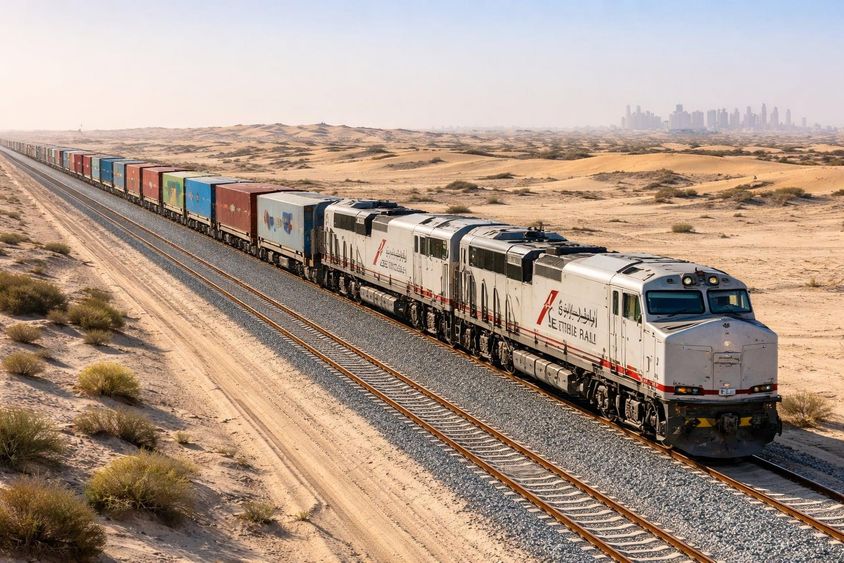
Etihad Rail: Railways Keep UAE Supply Chains Moving
In recent times, geopolitical tensions in various parts of the Middle East have posed significant challenges to regional logistics systems. Air and sea transport experience disruptions on certain routes, insurance costs rise, and ports and border crossings sometimes struggle with congestion. In this uncertain environment, any infrastructure capable of operating stably and reliably becomes particularly valuable. In the case of the United Arab Emirates, the national railway network developed by Etihad Rail plays a crucial role.
Statistics from the past nine days clearly show the importance of this system in the country's economic operations. Rail freight transport has launched more than a hundred trains in this short period, moving over 459,000 tons of goods and nearly 7,900 containers across various parts of the country. These numbers not only represent logistical performance but also prove that the United Arab Emirates can maintain stable supply chain operations even when disruptions occur in other parts of the region.
The Role of the National Railway Network in Supply Chains
One of the main objectives of establishing the national railway network was to strengthen the country's economic resilience. The logistics system doesn't just consist of ports and highways. For modern economies, it's essential that various modes of transport work complementarily.
The railway system plays exactly this role. It connects key industrial zones, logistics centers, and sea ports. This means that containers and goods can be transported quickly and predictably from one point to another without relying solely on road transport.
Road freight transport is, of course, still an important part of the logistics system, but rail significantly reduces road congestion while simultaneously transporting large quantities of goods. A single freight train can replace the cargo of dozens of trucks, which is advantageous not only economically but also environmentally.
More Than a Hundred Freight Trains in Nine Days
Due to recent events, some segments of regional supply chains faced difficulties. Sea transport takes longer on certain routes, and air cargo capacity is sometimes limited. In this situation, the railway network played a key role in ensuring the continuous movement of goods within the country.
The series of more than a hundred freight trains means that trains practically operated continuously between industrial and logistics centers. The 459,000 tons of cargo include a wide range of products, from industrial raw materials and construction products to containerized goods and various commercial shipments.
The nearly 7,900 containers also show that rail fits effectively into the modern intermodal logistics system. Containers can be easily transferred from ship to rail or truck to rail, making transport faster and more flexible.
New Corridors and Reinforced Capacity
To ensure supply chain stability, operators of the railway network have implemented additional measures. Extra rail corridors were activated, allowing traffic to be rerouted along alternative paths if necessary. This is particularly important during times when certain logistical nodes become overloaded.
The system's flexibility has been further enhanced by reallocating intermodal capacity. Parts of the cargo transport were redirected towards the ports on the country's eastern coastline, and the role of a key inland container terminal was strengthened. These steps helped ensure a continuous flow of goods within the country and prevent congestion.
The network's operation was also supported by launching five additional freight trains, providing extra capacity to meet increased demand.
Emergency Passenger Trains
The railway network plays an important role not only in freight transport but also, when necessary, in passenger transport. Recently, three emergency passenger trains were launched to assist citizens and residents in returning home from a border region to one of the major cities.
This step clearly shows that railway infrastructure is significant not only economically but also socially. A well-functioning national railway network can offer quick solutions in crises when other forms of transport are limited.
Safety and Operational Protocols
During the operation of the railway system, special attention is given to adhering to safety protocols. The network's operation is carried out in continuous coordination with authorities, and they constantly monitor current regional developments.
This is especially important at a time when geopolitical tensions are present in the region. Stable operation of logistics systems requires accurate information flow and quick operational decision-making.
The operators of the railway infrastructure therefore work in constant readiness to ensure continuity of services. The goal is clear: to enable the country's economy to function uninterruptedly even when uncertainty is experienced in surrounding regions.
Sustainable Logistics Solutions
The national railway system offers not only efficiency but also a more environmentally friendly alternative to road transport. The energy consumption of freight trains per ton is significantly lower than that of truck transport, which can greatly reduce carbon dioxide emissions.
As part of sustainability efforts, one freight terminal has been equipped with a solar-powered system. This step is an important milestone in the environmentally friendly development of railway infrastructure, and similar solutions are planned for other terminals in the future.
The combination of energy-efficient operation and high transport capacity results in a logistics system that is sustainable in the long term.
The Backbone of Future Logistics
Today, the national railway network has become one of the most important pillars of the United Arab Emirates' logistics infrastructure. The connections between industrial zones, ports, and logistics centers have become faster and more reliable, directly supporting the country's economic growth.
The more than a hundred freight train journeys carried out recently demonstrate that the system not only operates effectively in peaceful times but also provides a stable foundation for supply chains during crises.
As global trade becomes increasingly complex, infrastructures that can quickly adapt to changing circumstances will become more valuable. The United Arab Emirates' railway network is exactly such a system: modern, flexible, and strategically significant.
The performance of the past few days proves that railways are not just a mode of transportation but a key pillar of the country's economic stability. The functioning of supply chains, the continuity of trade, and the servicing of industrial production are all factors that require reliable infrastructure. The railway network increasingly fills this role in the United Arab Emirates' economic system.
If you find any errors on this page, please let us know via email.


