Dubai's Inclusive Transport: Sensory Rooms Revolution
Silence in the Hustle: New Sensory Rooms Appear at Dubai Bus Stations
Challenges of a Noisy World
For most people, urban transportation is a natural part of daily life. However, the noise, constant announcements, flickering lights, and crowd at bus stations are not manageable for everyone. This is especially true for children with autism, for whom these stimuli can easily become overwhelming. A simple journey might not only be exhausting but also become a particularly stressful experience.
Dubai's transportation system has taken a step forward in inclusivity. At one of the city's busiest transportation hubs, a solution has been implemented specifically designed to reduce sensory overload. This is not just a new service, but a shift in perspective: recognizing that transportation cannot be a uniform experience for everyone.
New Spaces for Tranquility
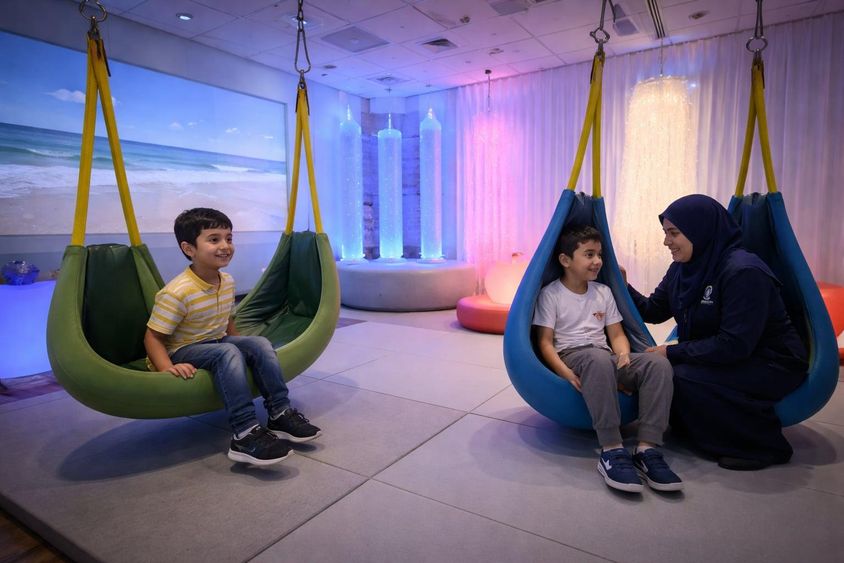
Special sensory rooms have been created at two bus stations in the city. These rooms are completely different from the usual waiting areas. They are designed not for quick transit but for relaxation. The goal is to create an environment where children and their families can detach from the noise of the outside world for a short time.
The design of the rooms is deliberate and thoroughly thought out. The lighting is not harsh or glaring but soft and low-intensity, with subtly changing colors to aid relaxation. This already makes a significant difference compared to the traditionally harshly lit transportation spaces.
The rooms also feature swings, which serve not just as play equipment but have therapeutic purposes. The gentle swinging motion has been proven to help calm the nervous system, especially in children who react more sensitively to external stimuli.
Conscious Use of Sounds and Sights
Reducing noise is crucial in such spaces. The sounds in the rooms are not random: soft, soothing music and natural sounds play, which help to counterbalance the noise from outside. This is particularly important because loud or unexpected noises are one of the most common triggers for sensory overload.
Visual elements also play a role. Images of calm, nature-related scenes appear on walls and displays. These do not overstimulate but rather provide a sense of security. The choice of colors and shapes is no accident: every element serves the purpose of reducing stress and providing a predictable environment.
Use in Daily Life
These rooms are not isolated, rarely used services. They operate as part of the system and can be used by children anytime before or after a journey. This can be especially useful before a long bus ride, when preparation is essential, or at the end of a tiring day when overload is already setting in.
For families, this serves as a safety net. They know there is a place to retreat if the environment becomes too intense. This awareness alone can reduce anxiety, even if the room ultimately doesn't need to be used.
Practical Implementation of Inclusive Thinking
Behind such initiatives lies not just technological development but a deeper societal perspective. In recent years, Dubai has increasingly focused on creating an accessible and livable environment for everyone. Supporting those with autism plays a key role in this.
As part of the project, transportation services are also being transformed. Not only is the physical infrastructure developing, but the whole system's approach is becoming more inclusive. This includes staff training, the development of information systems, and the introduction of innovative solutions like these sensory rooms.
Efficiency and Space Utilization
An interesting aspect of the development is that it was not realized by creating new buildings. Existing, underutilized spaces were transformed to provide a new function. This is not only a cost-effective solution but also sustainable, minimizing construction needs.
This approach shows that innovation does not always mean massive investments. Often, it is enough to rethink an existing system and have a better understanding of user needs.
International Recognition and Certification
The initiative has not gone unnoticed. The system has been awarded the autism-friendly environment certification, indicating that the implementation meets strict professional standards. This is not only recognition but a confirmation that the project truly works and provides real assistance.
Such certifications play an important role in inspiring other cities and organizations. A well-functioning model is more easily translatable to other environments, potentially having a global impact in the long run.
The Future of Transportation is Already Here
The future of transportation not only means faster and more efficient systems but also more human-centered solutions. The introduction of sensory rooms exemplifies how technology and empathy can meet in a single project.
With this step, Dubai is not only improving the quality of life for local residents but also setting a direction for other major cities. The question is no longer whether there is a need for such solutions, but when and how they will be implemented elsewhere.
More than a Service
This development goes beyond itself. It is not just a new function at bus stations but a message: transportation belongs to everyone. Even to those for whom usage has been difficult.
The tranquil spaces, consciously designed environments, and attention to detail all show that true progress is not just a technical matter. It is much more about understanding the diverse needs of people and being willing to adapt to them.
Dubai has now clearly taken a step forward. And while many cities around the world are just starting to think about similar solutions, inclusive transportation has already become a tangible reality here.
If you find any errors on this page, please let us know via email.


