Dubai's Hospitality: A Revolution in Kindness
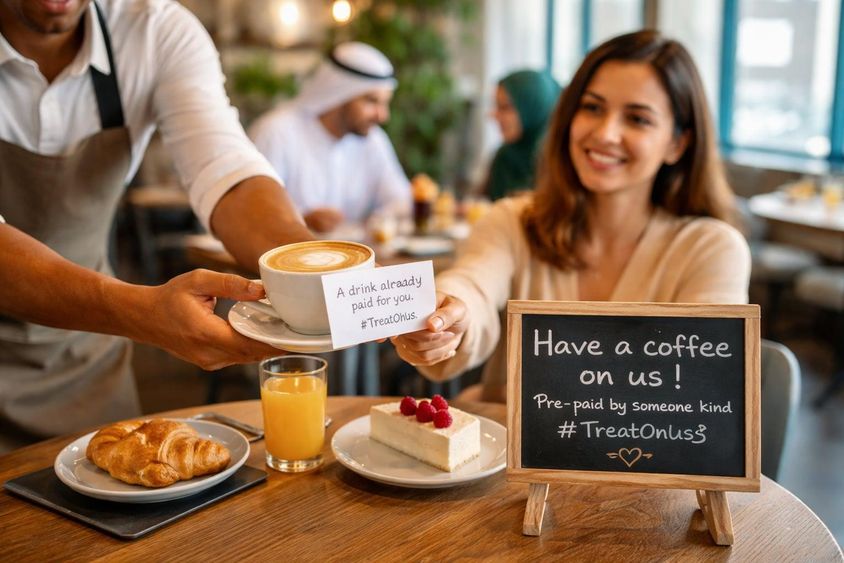
A new kind of hospitality approach in Dubai's restaurants
Dubai's gastronomic world has always been renowned for its ability to reinvent itself, but now an innovation has arrived from a completely different direction: it's not about the food, not the design, but human connections taking center stage. A new, community-based initiative has emerged, allowing anyone to pre-pay for a meal or drink for a stranger. This simple idea could spark a much deeper change in how we think about hospitality.
The reinterpretation of hospitality
The traditional dining experience typically involves two parties: the guest and the provider. However, this new model involves a third party: the person who pays but does not consume. This fundamentally transforms the system. Hospitality thus becomes more than just a transaction; it becomes a community experience where the focus is on giving and attentiveness.
This approach fits particularly well into Dubai's cultural environment, where generosity and community thinking are already present. The initiative does not aim to introduce new values, but rather to enhance and make visible the existing ones in everyday life.
How the system works in practice
The model is simple yet effective. Restaurants select a few items from their menu—like a coffee, dessert, or simpler dish—and set a fixed price for them. Guests can pre-pay for these items through an online platform, which will later go to another guest.
A key element of the system is that the money goes directly to the restaurants without an intermediary or commission. This ensures transparency and that the support truly reaches where it is needed. The restaurants then decide how to pass on these 'pre-paid' items.
The role of trust in the system
One of the most interesting elements of the initiative is that it doesn't rely on complicated rules or eligibility conditions. It is not defined who can receive such a gift. The system is based on trust: restaurants decide who to pass the pre-purchased meal or drink to.
This could be a regular customer, a tired worker, an unexpected tourist, or even someone in need. This flexibility makes the initiative truly humane, as decisions are made based on circumstances and feelings rather than rules.
The initial results and growth potential
Shortly after the platform's launch, it showed significant activity. Even in the first few days, hundreds of pre-paid items appeared in the system, indicating that residents are open to this new way of thinking.
The longer-term goals are even more ambitious: hundreds of such gestures daily, and thousands of moments monthly when someone receives an unexpected gift. Although these may seem like small things, they could significantly affect the city's atmosphere in aggregate.
Not charity, but a cultural phenomenon
It is important to note that this model is not a classic charity system. There are no strict categories, no administrative approval. Rather, it's a cultural phenomenon that could become part of daily life.
This approach is closer to the so-called 'suspended coffee' tradition, which has long existed in Europe. The essence is not who receives it, but that the gesture occurs. This spontaneity and simplicity make the idea truly strong.
Impact on the hospitality industry
The initiative is not only novel for guests but can also affect how restaurants operate. In such a system, hospitality returns to its roots: attentiveness, care, and creating experiences.
An unexpected gift can leave a much stronger impression on a guest than traditional service. In the long run, this can increase customer loyalty and establish a new kind of relationship between restaurants and the audience.
Why this could work particularly well in Dubai
Dubai is a unique city in that it is a melting pot of many cultures. Such initiatives can bridge this diversity through a shared experience.
The city's dynamics, continuous development, and openness to innovation all contribute to the rapid spread of such an idea. Additionally, the hospitality industry is exceptionally strong, providing an ideal ground for such experiments.
The future: a network of small gestures
If this model remains sustainable in the long term, it could give rise to a completely new urban culture. A system where it is part of daily life for someone to pay for someone else—not for a specific individual but for an unknown person.
This could not only strengthen relationships between individuals but also shape the overall ambiance of the city. Such small gestures, when summed, can create a friendlier, more open environment.
Conclusion: more than a trend
This new initiative is much more than a short-term trend or marketing gimmick. It points to a direction where hospitality is not just a service but a community experience and an emotional connection.
With this, Dubai again shows that it can innovate not only at a technological or architectural level but also in terms of human connections. And perhaps this is the area where the greatest impact can be achieved—with a simple coffee, an unexpected dessert, or a gesture that nobody expected. img_alt: A moment of prepaid kindness
If you find any errors on this page, please let us know via email.


