Dubai School Freezes Tuition Amid Uncertainty
Stability Amid Uncertainty
Dubai's education sector has shown continuous growth and development in recent years. However, the current geopolitical situation has brought new challenges to both families and institutions. The economic impacts of conflicts affecting the region have not gone unnoticed: many households have experienced reduced income, some have been forced into unpaid leave, and others face an unpredictable future. In this environment, every decision offering stability and predictability holds significant importance.
A Dubai school has recently taken a step that reflects this approach: for the third consecutive year, it has chosen not to increase tuition fees, despite having official permission to do so. This decision goes beyond a mere financial matter—it is rather seen as a form of social responsibility.
Freezing Tuition Fees as a Deliberate Strategy
Operating educational institutions is inherently costly, making tuition fee increases generally an unavoidable part of long-term sustainability. In Dubai, this process is overseen by a regulated system that allows schools to adjust fees. Therefore, it is particularly noteworthy when an institution consciously decides not to take advantage of this opportunity.
Keeping tuition fees unchanged for three consecutive years not only provides financial relief for families but also sends a strong message: the school is thinking long-term and prioritizes community interests over short-term revenues. This attitude plays a key role in building trust, especially during times when uncertainty is a constant factor.
Parallels with the Pandemic Period
The current situation in many ways resembles the previous global health crisis when educational institutions were also forced into making extraordinary decisions. During that time, there were schools that prioritized supporting families, even if it meant financial sacrifices in the short term.
The present decision continues this mindset. The leadership recognized that although a tuition increase would be justified and approved, the circumstances are not favorable for such a measure. Instead, they chose to maintain stability, which not only provides financial but also psychological relief for many parents.
Online School Year Start and New Realities
The 2026–27 school year began in online form in several institutions, showing that the system can quickly adapt to changing circumstances. This flexibility is crucial in a city like Dubai, where a significant portion of the population is foreign and comes from diverse economic backgrounds.
Online education, however, is not merely a technological issue. It poses serious organizational and pedagogical challenges and imposes additional burdens on many families. In this situation, freezing tuition fees acts as a counterbalance, helping to offset the extra difficulties stemming from the system.
The Role of Flexible Payment Solutions
While keeping tuition fees unchanged is a significant help on its own, the school has also introduced additional measures. Among them is the option for monthly installment payments, allowing families to better align their expenses with their income.
This approach is particularly important during times when incomes are not always predictable. Breaking down payments into monthly amounts reduces the burden of large one-time expenses and helps avoid situations where families need to quickly gather substantial sums.
In this case, flexibility isn't just a matter of convenience but serves as a real financial safety net.
Practical Assistance: Free Transport
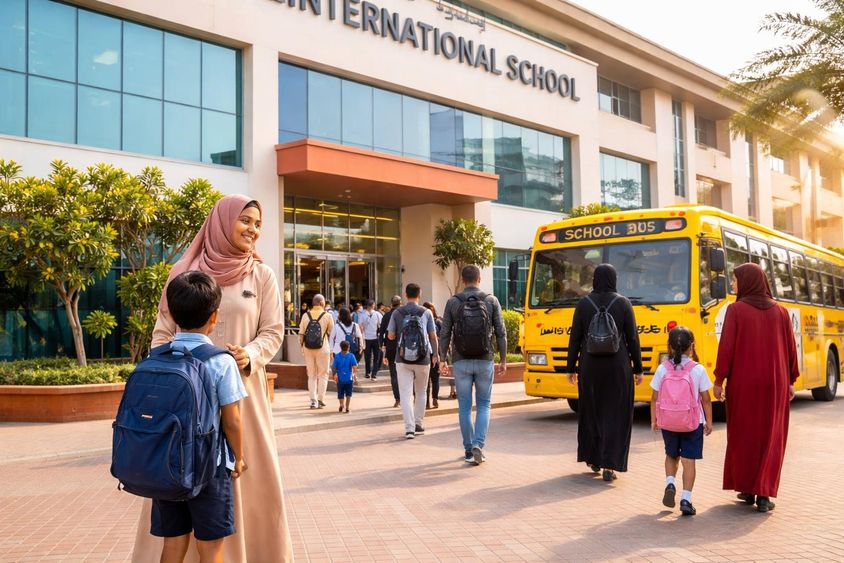
Alongside financial aids, the school introduced another form of everyday support: providing free transportation for certain communities. At first glance, this might seem like a small step, but in practice, it can mean significant cost savings for families.
Given Dubai's size and transportation system, commuting to school can often pose serious logistical challenges. Reducing travel costs not only presents a financial advantage but also saves parents time and energy.
This step shows that support extends beyond just the level of tuition fees, reaching into the practical areas of everyday life.
Community Orientation and Long-term Thinking
Behind such decisions, a community-focused mindset is clearly delineated. The school does not view itself as an isolated institution but as part of a network where families, students, and the wider social environment are closely connected.
In the long term, this mindset can offer significant competitive advantages. The trust built in such situations shapes parental decisions later on and strengthens the institution's reputation.
In Dubai's educational market, where options are broad and competition is fierce, such value-based decisions play a particularly crucial role.
What Can Be Expected in the Near Future?
The development of the current situation will greatly influence future decisions. If economic uncertainty persists, it's likely that similar measures will appear in the educational sector.
For schools, this presents a balance between financial sustainability and communal responsibility. However, the current examples indicate that models exist which can consider both perspectives.
In Summary: More Than a Financial Decision
At first glance, freezing tuition fees may seem like a simple economic step, but it holds much deeper significance. In a period dominated by uncertainty, every stable point becomes highly valued.
This example from Dubai's educational system shows that long-term thinking and commitment to the community can create real value. It not only eases the burden for families but also contributes to a more stable and predictable environment.
Ultimately, this is critical not just for education but for the society as a whole.
If you find any errors on this page, please let us know via email.


