Desert Drama: UAE's Weather Twist
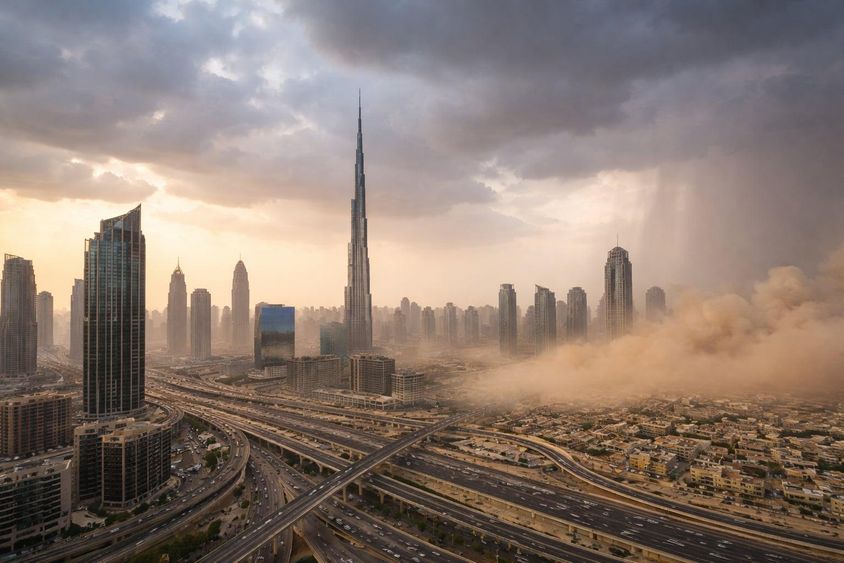
Variable Weather in the UAE: Dust, Rain, and Temperature Fluctuations in One Week.
The weather in the United Arab Emirates often seems predictable: hot days, clear skies, and little changing conditions characterize most of the year. However, from time to time, atmospheric processes develop that completely disrupt this stable picture. Such a period is now taking shape, which within a few days can bring heat, dust, rain, and sudden cooling.
This kind of variability is particularly interesting in a region where the weather usually does not show large fluctuations. According to current forecasts, a multi-day transitional period has begun, which clearly demonstrates how complex and dynamic desert climates can be.
Gradual Warming: Calm Before the Storm
The first days of the week start relatively quietly. Initially, the atmosphere is more stable, with varying cloud cover, but generally pleasant, partly sunny weather characterizes the country. At the same time, however, a clear rise in temperature is observable, which becomes increasingly intense over the weekend.
This warming is not accidental. A high-pressure system developing over the region and weak air movement favor the accumulation of heat. Daytime temperatures rise rapidly, while nights become milder. This phase is often deceptive because, on the surface, everything seems calm, while changes are already starting in the upper layers of the atmosphere that will lead to instability later.
Clouding and Tipping Point: Development of Instability
As the week progresses, gradual changes begin. The cloud cover starts to thicken, especially along the coast and around the islands. This is the first sign that the previous stable state is breaking down.
Moisture-laden air masses appear in the atmosphere, which meet with the warmed, dry air. This contrast forms the basis for unstable weather conditions. The clouds not only become more frequent but also thicker, covering larger areas.
This process is particularly important because it prepares the ground for the events expected mid-week. The atmospheric equilibrium upset at this point cannot be reversed in the short term, making the weather highly variable.
Dust Storms and Intensifying Winds: The Desert's Response
By mid-week, one of the most significant factors will be the strengthening of the wind. The refreshing air movement can reach speeds of up to 40 km/h, which in a desert environment has serious consequences.
The stronger wind easily lifts fine dust and sand, significantly reducing visibility. Dust storms are not only unpleasant but can also be dangerous, especially in terms of transport. For drivers, the biggest challenge at such times is the sudden drop in visibility and the layer of dust settling on the road surface.
Such situations are not uncommon around Dubai, showing that despite modern infrastructure, the forces of nature continue to have a significant impact on everyday life.
Rain in the Desert: Rare but Intense Phenomenon
Due to the unstable atmospheric conditions mid-week, precipitation may also develop. Although the UAE is not known for regular rains, during such periods short but intense showers can occur.
Especially in the western and eastern regions of the country, the chance of rain increases. These rainfalls are often localized, meaning they do not affect the entire country at once, but where they do appear, significant amounts of rain can fall in a short time.
This phenomenon can pose a serious challenge in urban areas, as drainage systems are not always able to immediately handle the sudden large amount of precipitation. Roads can become slippery, and temporary water accumulations can also occur.
Temperature Drop: The Final Stage of Turmoil
One of the most interesting elements of the unstable weather period is the temperature development. Following the initial warming, clear cooling is expected by mid to late week.
This change is closely related to the increase in cloud cover and the strengthening of the wind. Thicker clouds reduce the intensity of sunlight, while the wind continuously mixes the air, preventing heat from accumulating as before.
Although the drop in temperature may bring relief after the heat, the rapid change can be stressful for the body. This is especially true for those who spend a lot of time outdoors or engage in intense physical activity.
Sea Conditions: The Arabian Gulf Becomes Restless
The weather changes are not only felt on land but also at sea. Due to the strengthening wind, the water of the Arabian Gulf can occasionally become distinctly wavy, which is an important factor for navigation and water activities.
In contrast, the Gulf of Oman usually remains calmer during this period, showing how different sea regions react differently to the same atmospheric situation.
What Does This Mean for Everyday Life?
Such weather cycles remind us that even the most stable-seeming climate can drastically change in a short time. For the people living in the UAE and visitors alike, this requires adaptation.
It's important to pay attention to current forecasts, especially if one plans outdoor activities or travel. During dusty periods, it is advisable to travel with increased caution, while during rain, slippery roads and water overflows pose risks.
In the city of Dubai, such weather turns are particularly spectacular, as the meeting of the modern urban environment and the desert nature creates unique situations.
A Short but Insightful Period
This April weather wave well exemplifies that the region's climate is not static but a continuously changing system. The processes occurring within a few days – from warming to instability to cooling – are part of a complex atmospheric mechanism.
Although this period lasts relatively briefly, its impact is significant. It not only influences everyday life but also how people interpret the weather in the region.
The variability certainly demonstrates one thing: even in the desert, the weather is not always the same.
If you find any errors on this page, please let us know via email.


