Currency Swap Deal Between UAE and Bahrain
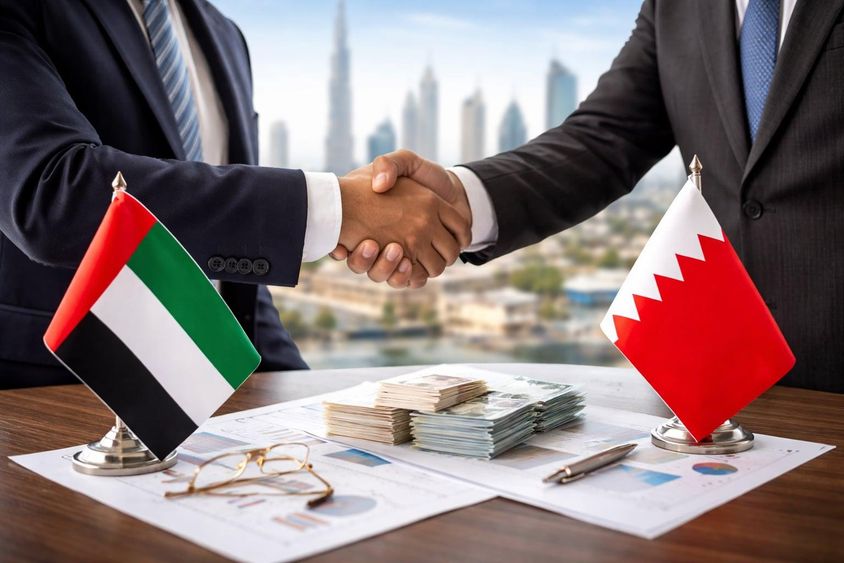
A New Financial Era in the Region: What Does the Currency Swap Agreement Between the UAE and Bahrain Mean?
The global economy increasingly focuses on flexibility and adaptability. In this environment, steps that reduce external exposure and strengthen regional cooperation hold significant importance. Such a crucial step was taken with the multi-billion dirham agreement signed between the United Arab Emirates and Bahrain. This decision does not merely represent the introduction of a technical financial tool but also sets a long-term strategic direction for the economic future of the region.
What is a currency swap, and why is it important?
A currency swap is a financial agreement that allows the central banks of two countries to make their currencies available to each other up to a predetermined limit. Initially, this might sound complicated, but in practice, it provides a very tangible benefit: companies and banks can more easily access the currency of the other country without having to rely on a third currency – such as the US dollar.
This mechanism is particularly important during periods when international markets are uncertain. Maintaining liquidity is a key issue in such times, and currency swap agreements provide precisely this stability. They serve not only as a safety net but also enable a swift response in unexpected economic situations.
Background and significance of the agreement
The multi-billion dirham agreement between the UAE and Bahrain, spanning five years, indicates that this is not a short-term experiment. Economic ties between the two countries have been strong, but this new step elevates cooperation to a higher level.
The purpose of the agreement is clear: to encourage the use of local currencies in trade and investments between the two countries. This means that the need for external currencies in transactions will diminish, reducing currency risk and costs.
This type of cooperation is particularly vital in the Persian Gulf region, where economies have similar structures yet face different challenges. Joint financial tools help these countries respond more uniformly to global changes.
What does it mean for companies?
One of the most tangible benefits of the currency swap agreement is seen at the company level. Businesses find it easier to conduct trade as they can directly access the partner country's currency. This not only makes transactions faster but also cheaper.
The use of intermediate currencies often incurs additional costs, such as conversion fees and exchange rate risks. These factors can become a significant burden in the long run, especially for large-scale trade. The current agreement alleviates this issue, making companies more competitive at both regional and global levels.
Additionally, increased financial stability enhances investor confidence. When a region's financial system is more predictable and resilient, it automatically becomes more attractive to international capital.
Declining role of the dollar?
One of the most intriguing aspects of this agreement is that it may contribute to the gradual decrease of the dollar's dominance in the region. While the dollar still plays a crucial role in international trade, more and more countries are seeking ways to reduce their dependency on this single currency.
Using local currencies is not just an economic issue but a strategic one as well. Countries able to conduct trade in their own currency enjoy greater independence within the global financial system.
This trend is not only observable in the Middle East but worldwide. An increasing number of central banks are entering similar agreements, which in the long run may lead to a much more balanced financial system.
Regional integration and perspective
This current agreement extends beyond the bilateral relations between the two countries. In fact, it is part of a broader process aimed at strengthening the region's economic integration. The Persian Gulf countries have long strived to develop closer cooperation, and this step fits well into this strategy.
Financial integration facilitates freer capital flow, reduces trade barriers, and contributes to economic growth. Moreover, it strengthens the region's global position, as a more unified economic area has greater weight on the international stage.
Connection to the Dubai economic model
Although the agreement was directly formed between two countries, its impact extends to the entire region, including Dubai's economic environment. Dubai has long sought to act as a global financial and trade center, and such agreements bolster this role.
The increased use of local currencies, for example, opens up new opportunities for financial service providers, fintech companies, and investors. Additionally, a more stable regional financial background makes Dubai even more attractive to international companies.
This is particularly important for a city whose economy relies heavily on international trade and investments.
Stability in an uncertain world
The current state of the global economy is fraught with challenges: geopolitical tensions, inflationary pressures, and market volatility characterize it. In this environment, any step that enhances stability and reduces risks is of paramount importance.
Currency swap agreements serve precisely this purpose. They are not spectacular measures but are incredibly important. These are background mechanisms that ensure the financial system remains operational even during difficult periods.
Summary
The currency swap agreement between the United Arab Emirates and Bahrain clearly goes beyond a simple financial tool. It is a strategic step that strengthens regional cooperation, reduces external dependency, and places economic relations on a more stable foundation.
For businesses, it means lower costs and simpler operations, for investors, greater security, and for the entire region, a stronger, more resilient economic system.
In the future, more such agreements are expected, collectively reshaping the global financial system. In this transformation, the region, including Dubai, can play a key role.
If you find any errors on this page, please let us know via email.


