Children Collect 'Passports' for Ramadan Joy
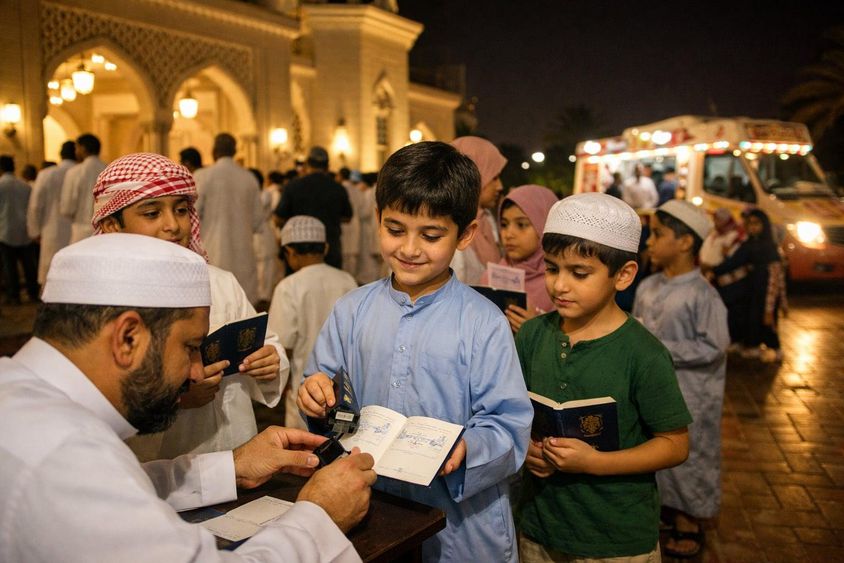
Children Collect 'Passports' and Stamps – Making Ramadan Evenings Memorable in Dubai Mosques
The month of Ramadan is a special time each year in the lives of Muslim communities. Fasting, evening prayers, and family gatherings hold deep spiritual significance, but they can also pose a challenge for families with young children. How can longer evening prayers be made enjoyable for the 6–12 age group? Dubai responds with a creative, community-building answer.
The 'Eyal Al Fareej' program, now in its second year, spans more than 300 mosques in the Dubai area. The objective of the initiative is simple yet highly effective: to endear children to the Taraweeh prayers and shape their connection to the mosque into a positive experience. As part of the program, children receive a special 'passport' that gets stamped each night they attend the prayer. Collecting these stamps has become an exciting motivation, instilling religious commitment through playful engagement.
Playful Motivation, Genuine Commitment
For children, the world often revolves around visual and tangible experiences. A personal 'passport' that gets a new stamp every evening is more than just paper and ink – it is a sense of achievement. Regular participation provides tangible proof, fostering healthy competition among siblings and friends while keeping the focus on prayers and communal presence.
Many parents report that their children no longer need to be encouraged to attend the mosque; they encourage each other. What makes the program special is that it doesn’t force or compel but turns it into an experience. Thus, religious duty gradually becomes an internal motivation.
Part of the Experience Is the Surprise
One of the program's most beloved elements is the surprise ice cream van visiting the participating mosques. For the children, this adds an extra element of excitement: will the sweet reward arrive that evening? Ice cream is not the primary motivation but a kind gesture that brings smiles and makes the evening even more memorable.
According to parents, the experience is complex for children: it's not merely about the treat but the shared anticipation, obtaining the stamp, greeting the imam, and receiving blessings that create the atmosphere making every evening special.
Connection to the Mosque and Community
A significant value of the program is in strengthening community bonds. Children not only participate in a prayer but become active members of the community space. They get to know the mosque’s imam, connect with other families, and learn that religious life is not isolated but a communal experience.
Many observe the touching moment when, after the prayer, a parent sends their child to the imam for the stamp. The imam greets them with a smile, gives blessings. These small gestures leave a deep impression on a child’s memory, turning the mosque into a safe, familiar place.
This type of experience-based education can have a long-term effect on developing religious identity. Children record the atmosphere of the Taraweeh prayers in their minds as a positive experience, rather than a duty.
Beyond Religious Practice
The 'Eyal Al Fareej' program is part of a broader campaign that focuses on community cohesion and cultural tradition during Ramadan. The aim is not merely to increase prayer attendance but to strengthen connections between generations.
Modern urban life—even in a dynamic, community-oriented city like Dubai—can easily isolate families from one another. Initiatives like these bridge the gap between neighborhoods, families, and religious communities. Children come together, wait for their stamps, and rejoice in their rewards together. Meanwhile, parents talk, exchange experiences, and share common memories.
The expansion of the program, now in over 300 mosques, shows a real demand for such creative solutions. It's not just a one-time action but a model to rethink how traditions can be brought closer to the world of today's children.
Ramadan Through the Eyes of Children
For children, Ramadan often means staying up late, having family dinners, and feeling the unique atmosphere. The 'passport' and stamp system add a new dimension to this. It structures the experience, gives purpose to the evenings, and allows children to perceive participation as a personal achievement.
Targeting the 6–12 age group is a conscious decision. This is the age when habits and attitudes are formed. If positive experiences are associated with mosques and prayers during this period, it can be pivotal in the long term.
With this program, Dubai has once again shown that tradition and innovation do not exclude each other. A simple yet creative idea – a child's passport and some stamps – has brought new excitement to Ramadan evenings.
Thus, the religious experience is not merely a duty but a shared adventure. For children, every evening becomes another stamp, another smile, another memory that may stay with them for life.
If you find any errors on this page, please let us know via email.


