A New Era in UAE Commuting
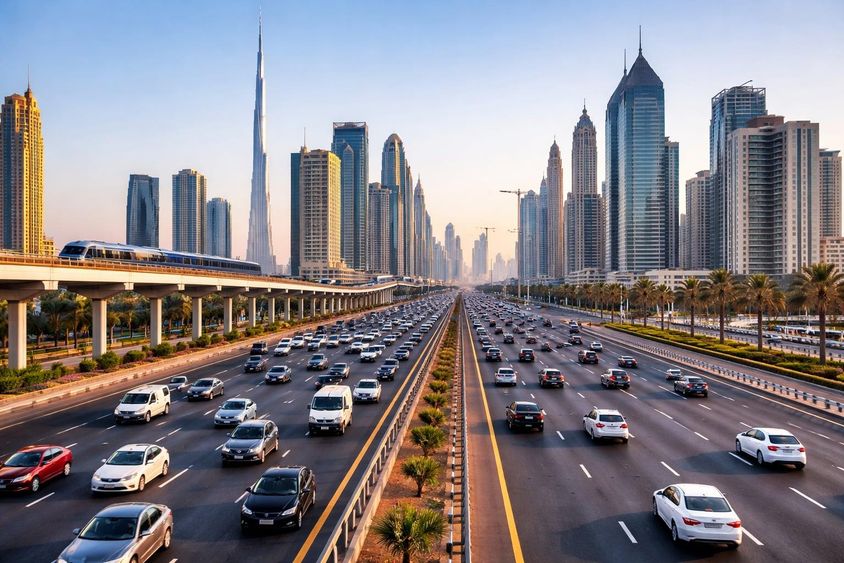
A New Era in Transportation: The Transformation of Commuting in the United Arab Emirates
For a long time, transportation in the United Arab Emirates has been one of the biggest challenges of rapid growth. Daily commuting between cities, especially between Dubai, Sharjah, and Ajman, has become an unpredictable and time-consuming process for many. In recent years, the saturation of roads, the explosive increase in the number of vehicles, and urbanization have collectively placed such pressure on infrastructure that it can no longer be ignored.
However, now a comprehensive, multi-level strategy is emerging that offers not just symptomatic treatment, but real structural changes. The goal is clear: to create faster, more predictable, and more sustainable transportation.
The real cause of congestion: not just the roads' fault
Most people tend to attribute traffic jams exclusively to the lack of road capacity, but the situation is more complex than that. The growth rate in the number of vehicles has reached a pace that far exceeds the international average. In Dubai, during the day, there are already millions of cars on the road, with annual growth in double digits.
This trend alone is enough to quickly saturate any infrastructure. The transportation system is therefore not merely "small," but continuously overburdened. This is where traditional solutions – such as building more lanes – are no longer sufficient on their own.
Faster buses, smarter city: the role of BRT systems
One of the most promising developments is the dedicated lanes for rapid bus systems, which essentially combine the flexibility of metro systems with the accessibility of buses. These systems are not stuck in traffic, thus significantly reducing travel time.
Dubai has already begun the establishment of such lanes, which drastically shorten travel time in some sections. This is not merely a matter of convenience: the goal is for people to see a real alternative to using their own cars.
The key to change lies in experience. If public transport is faster, more predictable, and more comfortable, people will willingly leave their cars at home.
Limiting the number of vehicles: a sensitive but inevitable step
One of the most sensitive issues is the increase in the number of vehicles. While car ownership is one of the symbols of economic development, beyond a certain point, it becomes a problem rather than an advantage.
Decision-makers are therefore examining regulatory options that can slow down the growth of the vehicle fleet. This does not necessarily mean a ban, but rather fine-tuned tools: such as changing registration conditions, altering incentives, or strengthening alternative forms of transport.
This approach can stabilize traffic in the long term, but it only works if real alternatives are available in parallel.
New highway, new opportunities: the fourth major transportation corridor
One of the most spectacular developments in the transportation system is a new multi-lane highway that could become one of the country's most important connecting routes. This project is not just about increasing capacity but also strategic rearrangement.
The new corridor alleviates existing routes, offers alternative options, and improves the efficiency of freight transportation. This is particularly important for the logistics sector, as fast and predictable transportation offers direct economic benefits.
The impact of such investments is not immediate, but in the long term, they fundamentally change the transportation map.
Strengthening everyday connections: residential areas and business centers
Alongside major projects, improving daily transportation is just as important. In many cases, the problem is not the lack of a road between two cities, but that the connection between residential areas and workplaces is not efficient enough.
Developments are therefore increasingly focused on ensuring people can quickly and directly reach their workplaces from home. This includes densifying the public transport network, simplifying transfers, and optimizing scheduling.
This kind of fine-tuning often has a greater impact on daily life than building a new highway.
Technology and communication: the invisible background system
Modern transportation cannot function without advanced technological background. Traffic management, data analysis, and system coordination all play a critical role in increasing efficiency.
In this process, communication solutions like Thuraya-based systems also play a role, ensuring data connectivity even under extreme conditions. These technologies are particularly important in maintaining the safe operation of transportation infrastructure, as they allow real-time coordination even when traditional networks are unavailable.
The future of transportation is therefore not just about concrete and asphalt but also about data and connectivity.
Sustainability and vision: the goal is not just eliminating traffic jams
A broader goal lies behind the developments: creating a transportation system that is not only efficient but sustainable as well. Lesser congestion means lower emissions, which has a direct impact on the quality of life.
Strengthening public transport, implementing smart systems, and controlling the number of vehicles all point toward this direction. This is not a quick fix but the beginning of a long-term transformation.
On the brink of a new everyday
The United Arab Emirates' transportation strategy clearly indicates that the current situation is not sustainable without changes. However, the measures now announced are not just reactions but part of a comprehensive vision.
If these plans are realized, commuting will not only become faster but also more predictable and livable. This could transform not only transportation but the rhythm of everyday life as well.
The question is no longer whether there is a need for change, but how quickly this vision will become reality.
If you find any errors on this page, please let us know via email.


