Why Dubai Temporarily Closed Its Churches?
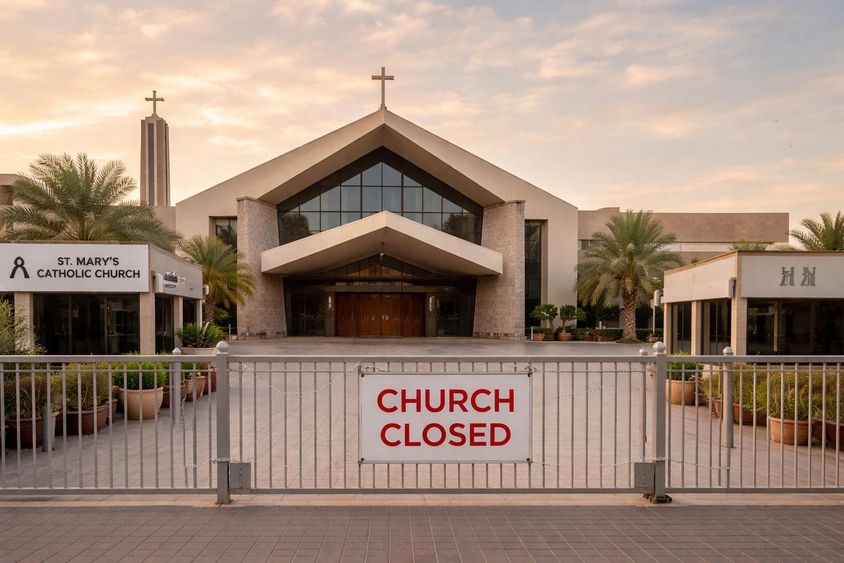
Why Were Churches in Dubai Temporarily Closed?
In Dubai, an extraordinary and surprising measure has been implemented: several churches and religious centers have temporarily suspended in-person services. The timing of this decision is particularly sensitive, as it coincides with Holy Week, one of the most crucial periods in the Christian world, which traditionally attracts the largest crowds to churches.
This, however, is not due to religious reasons but fits into a broader security and social context aimed at maintaining stability in Dubai and the entire region.
The Significance of Holy Week and the Weight of the Decision
Holy Week holds significant importance for Christian communities every year. This is the period when believers commemorate central events of their faith, with many participating in church services for the first time or less frequently.
In Dubai, churches typically see their largest gatherings during this time. Due to the city's multicultural nature, there are numerous Christians of various nationalities living there, for whom communal celebration is an essential social experience.
Therefore, the closures have substantial impacts on communities not only from logistical but also emotional perspectives. The absence of in-person presence appears as a loss to many, yet the reasons behind the decision put the situation into a broader perspective.
Security Considerations in the Background
The closure of churches is not an isolated decision but part of a comprehensive, preventive measure. Due to tensions in the region, authorities handle events attracting large crowds with heightened caution.
Religious sites are particularly sensitive points since they serve both as community and spiritual spaces. During festive occasions, several hundred or even thousands of people can gather in one place, requiring special attention from a security standpoint.
The decision-makers' goal is clear: to minimize any risks that could jeopardize the safety of the population. This precaution is a fundamental principle of modern urban management, especially in a dynamic and international environment like Dubai.
The Rise of Online Worship
Despite the closures, religious life has not come to a halt. Many communities quickly adapted to the situation by moving services online.
Internet broadcasts allow believers to join the events from home. While this does not entirely replace the in-person presence, it does provide a sense of continuity and community experience.
This trend is not new, but it has gained new momentum. Past experiences, particularly during the global pandemic, have shown that religious communities can flexibly respond to changing circumstances.
Not Only Churches Affected
It's important to note that not only Christian churches are affected. Other religious sites have also followed the guidelines and temporarily closed.
This indicates that the decision is not directed at a specific religion but is a general safety measure applying uniformly to all communities. The aim is a unified and consistent approach, strengthening social stability.
However, mosques remained open, although certain restrictions have been implemented there as well. For example, the reduction of outdoor prayer opportunities also indicates that authorities prefer controlled environments in every case.
Different Situations in Other Emirates
Interestingly, restrictions are not consistent everywhere. While in Dubai, in-person services have been temporarily suspended, churches in other emirates remain open.
This suggests that decisions are made locally, based on the specific security and social situation of the area. It's not a centralized, blanket prohibition but flexible adaptation.
This decentralized approach enables each emirate to make necessary measures according to their circumstances.
Community Reactions and Acceptance
Feedback indicates that most communities have met the decision with understanding. Although the lack of personal participation poses challenges for many, the general attitude is more supportive.
This is partly because Dubai's population is accustomed to swift and decisive measures, especially when they serve safety. Trust in the authorities is a key factor in this situation.
The high number of online participants also shows that communities strive to adapt and experience their traditions in a new form.
Strategic Thinking Behind the Decision
The closure of churches is not an isolated measure but part of a comprehensive strategy. Dubai aims to provide a stable, safe, and predictable environment for its residents and visitors in the long run.
This strategy often requires rapid response and caution, even if it causes inconveniences in the short term.
Therefore, the decision is not about restrictions but about protection. An approach built on prevention strengthens the resilience of the city in the long run.
When Might Normalcy Return?
Currently, the closures are temporary, and authorities continuously monitor developments. As soon as circumstances allow, a return to traditional, in-person services is expected.
This uncertainty poses a challenge but also provides the opportunity for communities to strengthen their connections in new ways.
The current situation is a reminder of how complex modern urban operations are and how maintaining security often requires compromises.
Summary
The temporary closure of churches in Dubai may initially seem like an unusual step, especially during a period when religious life plays a prominent role. However, a clear and consistent logic underlies the decision: the protection of the population above all else.
The situation clearly shows how a modern, global city can quickly adapt to changing circumstances while striving to preserve its community and cultural values.
The rise of digital solutions, the adaptability of communities, and the proactive approach of authorities together ensure that religious life doesn't come to a halt, but rather transforms.
And while the walls of the churches may be quieter now, the community remains alive—albeit in a new form.
If you find any errors on this page, please let us know via email.


