UAE Boosts Global Data Connectivity
Digital Sovereignty on New Foundations
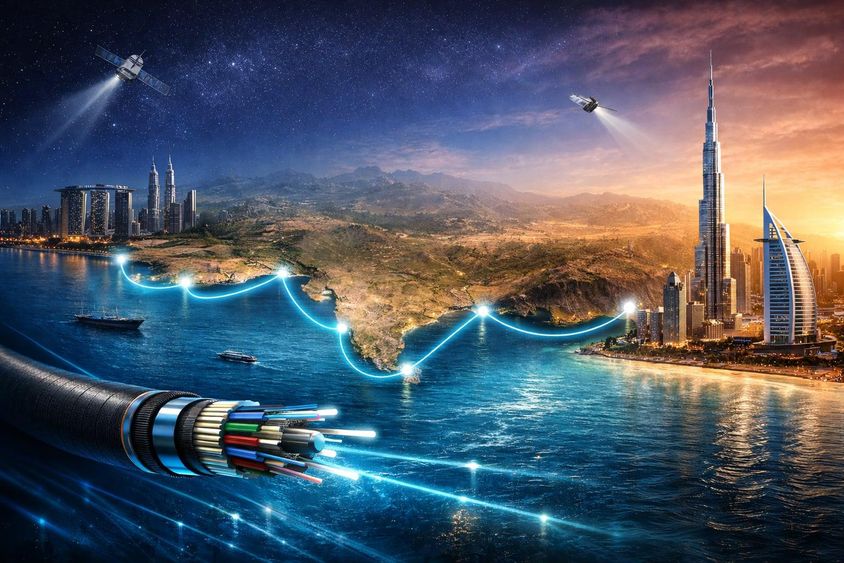
The United Arab Emirates has once again made a strategic move in the global digital space. Du is investing in the Singapore–India–Gulf (SING) submarine cable system, creating a new, high-capacity data corridor between Southeast Asia, India, and the Gulf region. This is not merely a network development; it is infrastructure policy.
The foundation of the modern economy is no longer solely energy or logistics. Data has become the new raw material. Those who can move data across continents faster, more securely, and with greater redundancy gain a competitive advantage. The UAE is building precisely in this direction.
Why is a submarine cable crucial?
The majority of global internet traffic does not travel by satellite but through submarine optical cables. These cables are the invisible arteries of the global economy. A single outage or overload can affect the data traffic of entire regions.
The SING system lands in Kalba in the UAE and further connects to Oman, India, Malaysia, and Singapore. This geographical arc creates an alternative, diversified route between East and West. Importantly, with this, the UAE reduces its dependency on traditional data routes, particularly in the Red Sea region.
Route diversification is not a technical detail. It is network resilience.
The Risk of the Red Sea and a Strategic Alternative
A significant portion of global data traffic passes through cable systems in the Red Sea. This is a geographically concentrated, geopolitically sensitive zone. Any disturbance – political, military, or physical – can impact traffic.
The new east-west digital corridor reduces this exposure. The UAE is not merely joining a project but actively shaping the global data traffic map. Digital stability is no longer an option, but a national security issue.
The Demands of the AI and Hyperscale Era
In recent years, the UAE has prioritized building AI-based innovation and advanced computing infrastructure. AI systems generate massive data traffic. Large language models, real-time analytics, industrial automation, and fintech all require low-latency, stable connectivity.
Hyperscale data centers cannot operate without reliable international backbone networks. Cloud service providers, global platforms, and multinational companies only deploy significant capacity in regions where data route redundancy is guaranteed.
The SING system meets this need. High bandwidth, low latency, scalable architecture.
Flexible Architecture for a Scaling Future
One key element of the system is flexibility. The network is designed to expand capacity as needed. As AI adoption accelerates in the UAE, and throughout the Gulf region, India, and Southeast Asia, bandwidth demand also rises steeply.
This is not a static system. It is a future-proof infrastructure capable of keeping up with technological leaps.
For hyperscalers, this is a critical aspect. For corporate clients, it is a guarantee that their business processes will not encounter network barriers.
Economic Impact in the UAE
The indirect impact of such investments is at least as significant as the direct technological advantage. The development of the data center ecosystem attracts new investments. Fintech, health tech, e-commerce, logistics, and the media industry all benefit from low-latency international connectivity.
Dubai is placed in a particularly strong position. The city is already a regional business and technology hub. The new cable system further strengthens this role, potentially becoming a key throughput point for global data traffic.
The infrastructure is not built for its own sake. Behind every optical fiber is a business model, investment, and innovation.
Geopolitical Dimension
Digital infrastructure has now become a geopolitical tool. Countries that control or influence major data routes gain strategic advantage.
With this step, the UAE positions itself not just as a regional player but as a global digital intermediary. It offers an alternative, stable, politically predictable data route between East and West.
This role represents significant diplomatic and economic weight in the long term.
Network Resilience as a Competitive Advantage
For modern companies, the biggest risk is data traffic disruption. A financial platform, an e-commerce system, or a global cloud service cannot afford multiple hours or days of downtime.
Route diversity, or route diversification, is a concrete competitive advantage. The UAE offers this to the global market: stability, redundancy, and high capacity.
The SING cable is not a spectacular project. It is not a skyscraper. It is not a tourist attraction. But its impact is deeper and more lasting.
The Infrastructure of the Next Decade
The volume of data traffic grows exponentially year on year. Video streaming, AI, IoT, industrial automation, and financial systems all demand more bandwidth. Those who build now provide a foundation for the next ten years.
The UAE's decision fits into a strategy that complements physical infrastructure – ports, airports, logistics centers – with digital backbones.
Global competition isn't slowing down. The question is who can move data quicker and more reliably.
With the SING system, the UAE has provided a clear answer to this question.
If you find any errors on this page, please let us know via email.