Lunar Observation Risks During Solar Eclipse
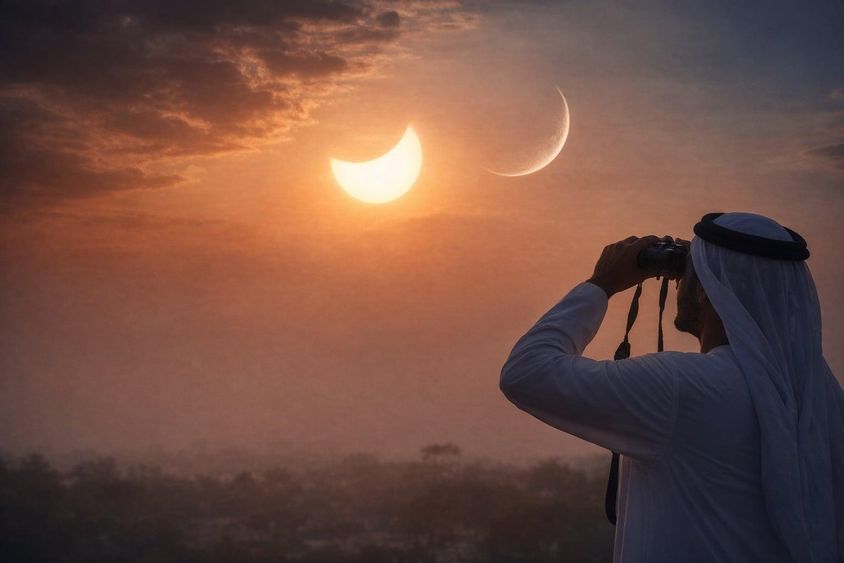
Observing the Moon During Solar Eclipse: Why it Could Be Dangerous to Look for the New Moon in the UAE on February 17
One of the most important moments in the Islamic lunar calendar each year is the observation of the new moon, which determines the start of each month - especially Ramadan. In the UAE and the wider region, traditionally, expert committees and volunteer observers look for the thin crescent moon after sunset. However, this year brings a unique astronomical situation on February 17 that experts are urging caution about: the extremely close apparent position of the moon and the sun, combined with a solar eclipse, could pose serious risks to those trying to observe the celestial event with telescopes or binoculars.
The essence of the warning is simple but could have severe consequences if not taken seriously. Direct observation of the sun without a proper, certified solar filter – be it through a telescope, binoculars, or any optical device – can cause permanent eye damage, even blindness. On February 17, the moon will be so close to the sun in the sky that searching for the crescent moon effectively means looking at the sun.
Why is the so-called angular distance important?
In astronomy, the apparent distance between the sun and the moon in the sky is measured as angular distance. This refers to the angle between the centers of these two celestial bodies, not the distance between their edges. On February 17, around sunset, this angular distance will be only about one degree in some areas of the region. For comparison, the apparent diameter of both the sun and the moon in the sky is roughly half a degree. This means that if a crescent moon forms at all, it would be about half a degree away from the sun's disk.
This represents an extreme proximity. Practically, any telescope aimed at the presumed position of the crescent moon will bring the sun into the field, or place it very close. In such a situation, the intense sunlight entering the optical system can damage not only the device but also the observer's eyes.
The solar eclipse may give a misleading sense of safety
A solar eclipse also occurs earlier that day. Many people tend to think that if the sun is partially covered, it reduces the danger. This, however, is a serious misconception. Even during a solar eclipse, there is enough radiation to cause severe eye damage. Moreover, as sunset approaches, the decrease in brightness can be deceptive: the low sun is less dazzling, but the magnification by optical devices concentrates the light, so the retina can be injured in an instant.
The human eye is particularly vulnerable because the sensation of pain is not immediate. The retina does not contain pain receptors, so the damage often only becomes apparent hours later, when it is already irreversible.
Astronomically, too, success is questionable
Apart from the safety risks, the observability of the new moon on this evening is also questionable from a professional standpoint. If someone waits until the sun has completely set below the horizon, the lower edge of the moon will also disappear below the sight line. This means that by the time it would be safer to observe, the sought-after crescent moon would no longer be visible.
This is the so-called "astronomically impractical" situation. The movements of celestial bodies do not align with earthly traditions. The trajectories of the moon and sun are fixed, and on certain days, the observation conditions are simply not favorable.
Meeting of tradition and science in the UAE
In the UAE, observing the new moon is not just an astronomical matter but also a religious and community event. At the same time, in recent years, the country has undergone significant scientific and space exploration advancements, leading authorities and professional organizations to place increasing emphasis on science-based communication.
Some countries in the region have already announced the start date of Ramadan in advance, citing the accuracy of calculations and the principle of not accepting reports that contradict observable reality or scientific certainty. This showcases an emerging dialogue between modern astronomical models and traditional crescent moon sighting.
It is essential to emphasize that the role of scientific organizations is primarily to inform and warn about safety. Official decisions belong to the competent religious and state bodies.
What does this mean in practice?
The most important message: no one should try to look in the direction of the sun with optical devices without a proper, certified solar filter. Not even if the goal is to find the crescent moon, and not even if the sun is already low. Professional observatories use specialized equipment and internationally recognized safety protocols. These devices are not the same as commercially available hobby telescopes.
For amateur observers, the safest solution is to rely on official announcements. Modern calculation methods and precise astronomical data reliably predict the phases of the moon. Celestial mechanics leave no room for uncertainty in the sense of when and where the moon will appear.
Protecting vision above all
Losing vision or suffering permanent damage is a price not worth paying for any observational attempt. The situation on February 17 is particularly sensitive because the extreme proximity of the sun and moon creates a trap situation where curiosity can easily override caution.
Astronomy is a fascinating science that has inspired humanity for millennia. However, observing the sky also comes with responsibility. The laws of nature do not adapt to human expectations, and there is no exception to the rules of physics.
The warning from UAE experts is, therefore, not an exaggeration but a precautionary step. Safe observation is always paramount, especially when celestial bodies are in such rare and potentially dangerous configurations as on February 17. Awareness, self-restraint, and adherence to official guidelines ensure that the respect for community and religious traditions does not come with health risks.
If you find any errors on this page, please let us know via email.


